The 20-Minute Writing Loop That Makes Threads Easy
You don't need an hour to write a Threads post. Here's the 20-minute loop that produces publish-ready content daily without burnout.

In this post, you'll learn:
Why long writing sessions kill consistency (and what to do instead)
The 20-minute loop that produces publish-ready Threads posts
How to go from blank screen to done in the time it takes to drink a coffee
The Answer (direct, 40-70 words)
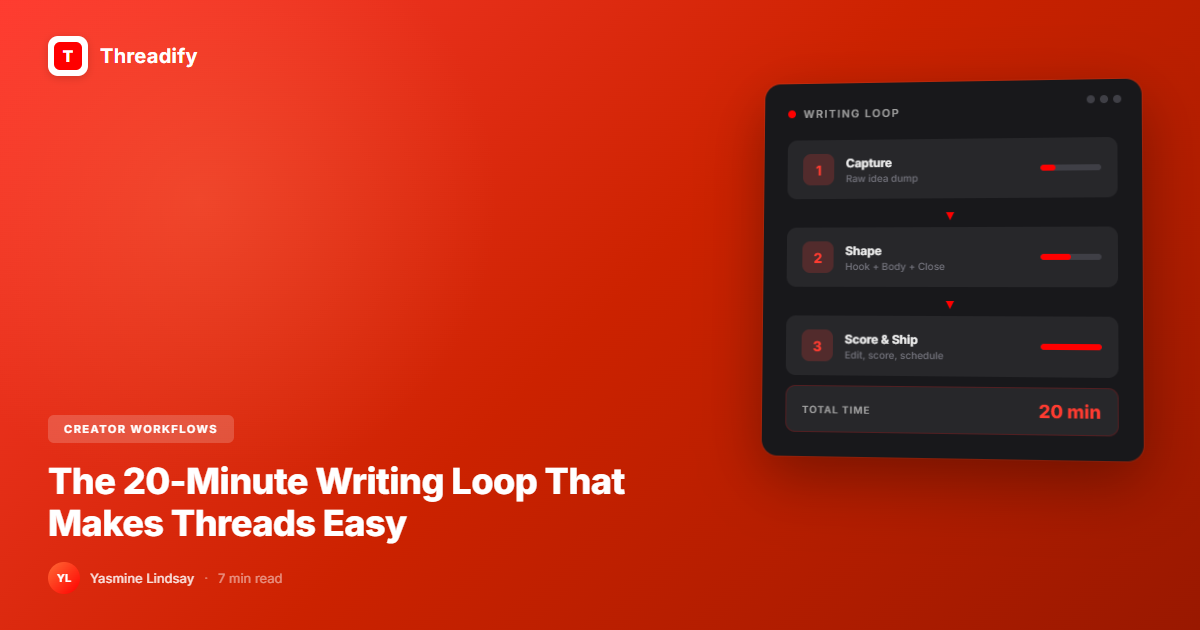
You don't need an hour to create a great Threads post. You need 20 focused minutes and a repeatable loop: 5 minutes to capture a raw idea, 10 minutes to shape it into a post, 5 minutes to score and polish. The loop works because it's small enough to do daily and structured enough to produce quality consistently.
Quick Steps
Set a 20-minute timer.
Minutes 1-5: Capture a raw idea (experience, opinion, observation).
Minutes 6-15: Shape it into a post (hook → body → close).
Minutes 16-20: Score, edit, and schedule.
Done. Walk away. Do not touch it again.
Repeat tomorrow.
Why You Can’t “Find Time” to Post
Let’s be honest about why most people aren’t consistent on Threads.
It’s not that they don’t have ideas. It’s not that they don’t care. It’s that every time they sit down to write, it turns into a 90-minute odyssey of:
staring at a blank screen
writing three different versions
deleting all of them
scrolling other people’s posts for “inspiration”
feeling worse
closing the app
Sound familiar?
The problem isn’t discipline. The problem is scope. You’re treating every post like a project instead of a rep.
Definition block: Writing loop
A writing loop is a time-boxed, repeatable process for producing content. Unlike “writing sessions” (open-ended, often unstructured), a loop has fixed stages, a hard time limit, and a clear “done” signal. The constraint is the feature — it prevents overthinking.
The Loop: 20 Minutes, 3 Stages
Stage 1: Capture (5 minutes)
Open a blank note. Answer ONE of these prompts:
What’s something I experienced this week that others might relate to?
What’s a common belief in my niche that I disagree with?
What’s a question someone asked me recently?
What worked (or failed) in my business/content this week?
Write the answer in messy, stream-of-consciousness style. No editing. No formatting. Just dump the idea.
The rule: if you don’t have an idea in 2 minutes, pick the last interesting thing someone said to you and riff on it.
You’re not looking for brilliance. You’re looking for something real.
Try Threadify for free
Write better Threads in less time. Generate, refine, schedule—without the chaos.
Stage 2: Shape (10 minutes)
Take your raw idea and structure it:
Hook (1-2 lines): What’s the most surprising, provocative, or relatable version of this idea?
Bad: “I learned something about content today.” Good: “I mass-deleted 30 drafts. Best decision I made this month.”
Body (5-8 lines): Explain the point. One idea. Specific details. Short sentences.
The body should answer: why does this matter to someone scrolling right now?
Use these micro-structures:
Story → Lesson: “This happened → here’s what I took from it”
Myth → Reality: “Everyone says X → but actually Y”
Problem → Fix: “This sucks → here’s what works instead”
Close (1-2 lines): Give a reason to engage. Ask a question. Make a statement worth saving.
Stage 3: Score & Ship (5 minutes)
Read it once out loud. If any sentence makes you cringe, cut it.
Then score it:
Does the hook stop a scroll? (If not, rewrite the first line only.)
Is there one clear point? (If you can’t summarise it in one sentence, it’s two posts. Split it.)
Would you reply to this if someone else posted it?
Threadify’s Score feature automates this — paste your draft, get instant feedback on hook strength, readability, and engagement prediction. Fix what it flags. Schedule.
Done. Walk away. Do not go back and “just tweak one thing.” That’s how 20 minutes becomes 2 hours.
The Threadify Score Contrast
Weak Hook: “Some thoughts on writing consistently on Threads” (Threadify Score: 25/100 — vague, no tension, sounds like homework)
Fixed Hook: “I write every Threads post in 20 minutes or less. Here’s the exact loop.” (Threadify Score: 89/100 — specific, curiosity-inducing, promise of a system)
Why 20 Minutes Works (The Psychology)
There’s a reason the loop is 20 minutes and not 60.
Parkinson’s Law: Work expands to fill the time available. Give yourself an hour and you’ll use the hour — mostly on overthinking. Give yourself 20 minutes and you’ll cut straight to the point.
Decision fatigue: The more choices you face, the worse your decisions get. A structured loop eliminates most decisions: you don’t decide what to write (the prompts do that), how to structure it (the template does that), or when to stop (the timer does that).
Consistency > intensity: One 20-minute session per day beats one 3-hour session per week. The algorithm rewards showing up. Your audience rewards predictability. Your brain rewards routine.
The Objections (And Why They’re Wrong)
“20 minutes isn’t enough for quality content”
Most viral Threads posts are 50-150 words. That’s less than what you just read in this section. Quality on Threads isn’t about length — it’s about specificity and emotion.
“I can’t write that fast”
You’re not writing a blog post. You’re writing a thought. The capture stage is deliberately messy. The shaping stage is fill-in-the-blank. You’re faster than you think when the structure is pre-decided.
“What if the post isn’t perfect?”
It won’t be. That’s fine. A published 7/10 beats an unpublished 10/10 every single time. You can always repost a refined version later — that’s literally what auto repost is for.
Building the Habit Stack
The loop works best when it’s anchored to something you already do:
Morning coffee + 20-minute loop → post goes out by 9am
Lunch break + 20-minute loop → afternoon content sorted
End of workday + 20-minute loop → next-day post scheduled
Pick one anchor. Same time every day. The consistency compounds.
After 7 days, you’ll have 7 posts. After 30 days, 30 posts. After 90 days, you’ll wonder why you ever thought content was hard.
Evidence Sandwich: The Compound Effect of Daily Reps
Creators who post daily on Threads grow 4-6x faster than those who post weekly. Not because each post is better — but because:
The algorithm favours active accounts
More posts = more chances for one to break through
Daily writing makes you a better writer (reps > talent)
Your audience builds the habit of seeing you
The 20-minute loop makes daily posting sustainable. It doesn’t demand energy you don’t have. It fits in the margins.
Your Next Step
Set a timer right now. 20 minutes. Write one post using the loop.
Don’t think about whether it’s good enough. Just complete the loop.
Capture → Shape → Score → Done.
Tomorrow, do it again. That’s the entire strategy.
Related reads:
Score It Before You Post It — the pre-publish quality system
The Modular Thread Stack — turn one idea into multiple posts
How to get more followers on Threads — the growth tactics that compound with daily posting
Frequently Asked Questions
How long should a Threads post take to write?+
A quality Threads post should take 20 minutes or less using a structured loop. Most viral posts are 50-150 words, which is far less than a blog post. Quality on Threads comes from specificity and emotion, not length.
What is the 20-minute writing loop?+
The 20-minute writing loop is a time-boxed process with three stages: 5 minutes to capture a raw idea, 10 minutes to shape it into a structured post (hook, body, close), and 5 minutes to score, edit, and schedule. The constraint prevents overthinking.
How can I write Threads posts faster?+
Use a repeatable structure that eliminates decisions. Pre-decide your writing prompts, use a fill-in-the-blank post template (hook, body, close), and set a hard 20-minute timer. Consistency beats intensity.
How many Threads posts should I write in one session?+
Aim for two to three in a focused 20-minute loop — enough to build a buffer without burning out. Quality drops fast past the 20-minute mark, so ship what you have and come back tomorrow.
What tools speed up the Threads writing loop?+
A fixed template (hook → body → close), a swipe file of past winners, and an AI assistant like Threadify that drafts in your voice cut blank-page time to near zero, so the 20 minutes goes to editing instead of staring.
Do I need a full hour to create good Threads content?+
No. Most creators think they need long writing sessions, but that kills consistency. A focused 20-minute loop beats sporadic 90-minute sessions because it builds a daily habit the algorithm rewards.
What if my Threads post isn't perfect after 20 minutes?+
Ship it anyway. A published 7/10 post beats an unpublished 10/10 every time, and you can always refine or repost later with Auto Repost. Perfectionism is the enemy of consistency.
Try Threadify for free
Write better Threads in less time. Generate, refine, schedule—without the chaos.