How a Non-Technical Founder Uses AI Agents to Run a SaaS (82 Skills, $0 in Code)
My co-founder Lenny runs Threadify operations with 3 AI agents and 82 custom skills. No engineering degree. No coding. Here's the honest breakdown of what that actually looks like.

How a Non-Technical Founder Uses 3 AI Agents and 82 Skills to Run a Real SaaS
What is a non-technical founder AI agent setup?
A non-technical founder AI agent setup is a system of specialized autonomous AI agents — each configured with a narrow set of skills — that handles content, marketing, operations, and community management without requiring the founder to write code. Instead of one general AI doing everything badly, you build multiple focused agents, each with expertise in a specific domain. At Threadify, this looks like three agents with 82 combined skills doing the daily work of a full marketing and operations department for roughly $200/month in running costs.
Let me tell you about the moment my co-founder Lenny almost had a heart attack.
It's February 15th, 2026. Peter Steinberger — the creator of OpenClaw, the most starred open-source project in GitHub history — announces he's leaving to join OpenAI. TechCrunch is on it. Bloomberg picks it up. Every tech journalist alive is scrambling to write the same take.
And Lenny? He's sitting there with 32K in savings, 10 months of runway, and an entire business held together by three OpenClaw agents.
He made a video about it. Not a reaction video. Not a hot take. A real look at what it means when the tool your business depends on gets absorbed by the biggest AI company on the planet — and you can't write a single line of code yourself.
Here's why I think every non-technical founder building with AI needs to pay attention.
The Setup Nobody Else Is Showing You
Most people covering the OpenClaw-to-OpenAI story are developers. They're talking about architecture, forks, and API compatibility. That's fine. But none of them are actually running a business on this thing.
We are.
Threadify — the Threads creator workspace Lenny, Samsam, and I built — is doing just shy of $6,500 MRR across our products. Monthly recurring. Real Stripe revenue. Not "projected ARR" math that founders love to throw around on Twitter.
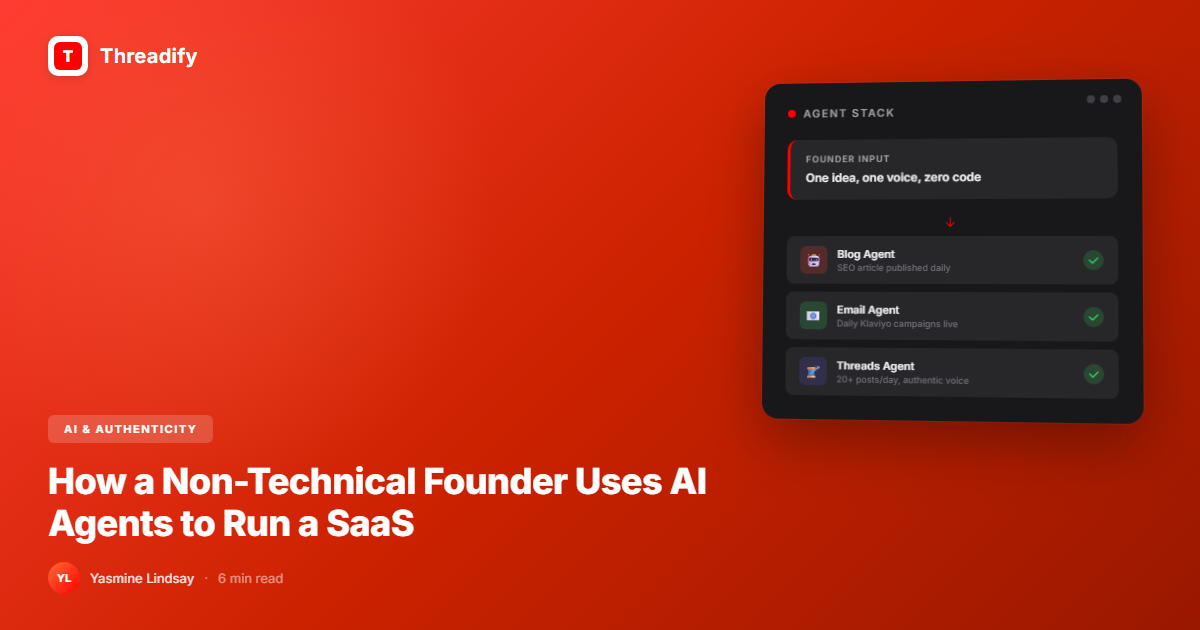
And the engine behind it? Three AI agents, each running on OpenClaw, with a combined 82 custom skills between them.
Here's the breakdown:
Clarity (Lenny's agent, Mac Mini) — Handles Threadify operations, triages emails, drafts content, manages the second brain, curates viral hooks for the Threadify Vault
Sammy (Mac Mini) — Runs community operations for Full Circle, triages Skool notifications and DMs, operates 24/7
Anchor (my agent, PC) — Email marketing, blog writing, analytics, and about a dozen other things I used to do manually in my old corporate content marketing job
Each agent has its own personality built from its skill configuration. Clarity is the strategist. Sammy is the community operator. Anchor is the marketing department I never could have hired.
Why This Matters for Non-Technical Founders
Here's the part Lenny was brutally honest about in his video, and it's the part I respect most: he cannot code. No computer science degree. Quit law school the day after graduating. Blew 80K on an online course nobody wanted.
And yet he's running a SaaS with AI agents doing meaningful work every single day.
I want to be equally transparent. I came from corporate content marketing making £23,000 a year. I once generated over £100,000 in a month for a company that paid me barely enough to cover London rent. Now my agent Anchor does that same caliber of work for about £200 a month — the cost of an Anthropic Claude Max subscription.
That's not a flex. That's the reality of what these tools enable when you stop treating AI as a chatbot and start treating it as infrastructure.
The key insight most people miss: it's not about one AI doing everything. It's about building a system of specialized agents, each with narrowly defined skills, working together like a team. The same way you'd build an actual company — except your employees don't need health insurance and they work at 3 AM without complaining.
What 82 Skills Actually Looks Like
When people hear "82 skills," they picture something impossibly complex. It's not. Think of each skill like a job description for a very focused employee.
Under Clarity alone, there are skills for:
Research and analysis
Try Threadify for free
Write better Threads in less time. Generate, refine, schedule—without the chaos.
YouTube metadata and hooks
Thumbnail evaluation
Script drafting and editing
Newsletter content
Second brain logging
Each skill is a specialist. The research skill doesn't try to write thumbnails. The thumbnail skill doesn't try to draft newsletters. You compose them together, and the agent figures out which skill to activate based on what you need.
This is the same philosophy behind how we built Threadify's modular thread system — small, composable pieces that combine into something powerful. Whether you're stacking thread components or AI skills, modularity wins.
The Raw Numbers (No Highlight Reel)
Lenny shared these in the video and I'm going to repeat them here because building in public means the uncomfortable numbers too:
MRR: $1,635
Total users: 555
Active subscriptions: 73
Revenue retention: 100% gross and net
Savings: $32,000
Monthly expenses: ~$3,400
Take-home after fees: $200-300/month
Runway: ~10 months
Ten months to hit roughly $10K/month or it's back to what Lenny calls "corporate slavery."
That's real pressure. And honestly? That pressure is exactly why the AI agent setup matters so much. When you're burning runway with no engineering budget, the ability to automate marketing, content, community management, and operations with tools that cost a couple hundred dollars a month isn't a nice-to-have. It's survival.
The Honest Caveat (Because We Don't Do Highlight Reels)
Lenny said something in the video that I want to amplify because it's important: he has Samsam. Sam is the software engineer. When something breaks — and things break — Sam checks it before anything ships to production.
We're not pretending three non-technical people duct-taped a SaaS together with vibes and prompts. The AI agents handle an enormous amount of work. But having an engineer as a co-founder is a genuine advantage, and pretending otherwise would be dishonest.
That said, what Lenny does daily — the content, the operations, the strategy, the community building — none of that requires code. And that's the part that transfers to you whether you have an engineer on your team or not.
If you're a solo creator trying to build a real presence on Threads or any other platform, this model works at any scale. You don't need 82 skills. Start with three. Automate the thing you hate doing most, and expand from there.
What the OpenAI Acquisition Means Going Forward
Three things matter from the Peter-joining-OpenAI news:
OpenClaw stays open-source and free. OpenAI committed to this publicly. The code isn't going anywhere.
Anthropic fumbled. The project started as Claudebot, built on their models. A trademark complaint pushed the creator away. That's a strategic error they'll feel for years.
OpenAI will integrate this into something bigger. Sam Altman's quote about "the next generation of personal agents" and making it "core to product offerings" tells you exactly where this is headed. My bet is ChatGPT desktop integration within months.
For non-technical founders, this is overwhelmingly good news. More resources, more stability, and eventually a more polished product — all while keeping the open-source foundation that lets people like us customize it for our specific businesses.
The Real Thesis
Non-technical founders using AI agent systems to build real products with real revenue: that's the story most people aren't telling yet. Not AI reviewers doing sponsored content. Not developers showing off configurations. Not business coaches selling courses about tools they've never shipped. The people who are actually in the arena, burning runway, building features with AI agents, trying to make it work before the savings run out.
That's us. That's what we're documenting. And whether you're building a SaaS, a community, or a content business, the playbook is the same: treat AI as your team, build specialized skills, and compound the work over time.
The Part Where I Tell You About Threadify
Look, you read this far, so I'll keep it quick.
Threadify is the workspace we built for people who are serious about Threads. Analyze what's working, draft content that doesn't read like AI slop, schedule posts, and run your entire content operation from one place.
Auto Plug puts your best-performing posts back in rotation automatically. Score tells you which drafts will actually perform before you post them. The Knowledge Base trains the AI on your voice so it stops sounding like a LinkedIn robot.
If you're one of those people who hates marketing but knows you need it, this is built specifically for you.
Creator plan is $19/month. Start with a 7-day free trial. Start at www.threadify.app
And if you want to follow along with the full building-in-public journey — the wins, the failures, the runway countdown — subscribe to Lenny's channel. He's not sugarcoating any of it, and neither am I.
Ten months. Let's see what happens.
Frequently Asked Questions
Can a non-technical founder actually run a SaaS with AI agents?+
Yes. A non-technical founder can use AI agents to handle content, operations, community management, and marketing without writing code. At Threadify, three agents with 82 combined skills handle the work of a full marketing and operations department for roughly $200/month in running costs.
How many AI agents does a small startup need?+
Most small teams need 2-3 specialized agents: one for operations, one for community management, and one for marketing. Start with the agent that handles what you hate doing most, then expand. Specialization matters more than having many agents.
What does it cost to run AI agents for a startup?+
At Threadify, three agents with 82 skills cost approximately $200-300/month in model subscription fees — versus $3,000-10,000+/month for equivalent human headcount. The savings are biggest for content, community, and marketing operations.
Do I need a technical co-founder to use AI agents?+
You don't need engineering skills to run AI agents for marketing, content, or community work. But a technical co-founder handles infrastructure and debugging that AI agents can't replace. Know the difference between what agents can own and what needs a human engineer.
What is the difference between an AI tool and an AI agent system?+
An AI tool responds to individual prompts. An AI agent system runs autonomously across many tasks with specialized skills, memory, and context. A tool is a hammer. An agent system is a team that works while you sleep.
Try Threadify for free
Write better Threads in less time. Generate, refine, schedule—without the chaos.