I Posted on Threads Every Day for 90 Days: Here's What Actually Happened
I posted on Threads every day for 90 days. The first 30 days were slow. The next 30 showed patterns. The final 30 were where everything compounded. Here are the real numbers and the system that made it sustainable.

I Posted on Threads Every Day for 90 Days: Here's What Actually Happened
In this post, you'll learn:
- What happens when you commit to daily Threads posting for 90 days straight
- The real numbers: followers, reach, engagement, and what the metrics don't tell you
- The system that made it sustainable (and the weeks that almost broke it)
The Answer (direct, 40-70 words)
Posting on Threads every day for 90 days didn't go viral. It did something better. It compounded. The first 30 days were slow and discouraging. The next 30 showed patterns. The final 30 were where everything clicked: consistent reach, real conversations, and an audience that actually knew who I was. The magic wasn't any single post. It was the system that kept me showing up.
Quick Steps
- Commit to 90 days, not 30. The compound effect kicks in after week 6.
- Batch-write weekly so posting doesn't depend on daily motivation.
- Track engagement (replies, saves), not vanity metrics (impressions).
- Double down on what works after week 2. Your data will show you.
- Build a swipe file of your top performers for future content.
- Survive the "dead zone" (days 8-21). It gets better.
Why 90 Days?
Everyone talks about "post consistently" but nobody talks about how long it actually takes to see results.
30 days? That's a warm-up. You're still figuring out what to post and who your audience is.
60 days? Better. Patterns start emerging. But you haven't compounded yet.
90 days is where the shift happens. Your audience knows you. The algorithm knows you. You know you: what works, what doesn't, what you actually enjoy writing about.
So I committed to 90 days of daily Threads posting. Here's the unfiltered timeline.
Days 1-7: The Honeymoon
Everything felt exciting. I had energy. I had ideas. I was posting with enthusiasm and replying to everyone.
The numbers:
- Posts: 7
- New followers: ~40
- Average engagement: 5-8 likes, 1-2 replies per post
- Best post: An opinion about AI content (14 likes, 6 replies)
What I learned: My first instinct about what to post was mostly wrong. The posts I thought were "great" got crickets. The throwaway opinion I almost didn't publish was my best performer.
Lesson: Your audience decides what's good. Not you.
Days 8-21: The Dead Zone
This is where most people quit. The excitement wore off. I was posting into what felt like a void. Some days got 3 likes. Some got 0 replies.
The numbers:
- Posts: 14
- New followers: ~60 (total ~100)
- Average engagement: 4-6 likes, 0-2 replies
- Worst day: A post I spent 30 minutes writing got 1 like. From my mom.
What it felt like: Pointless. Like shouting into a room where nobody was listening. Every day I had to fight the urge to skip "just one day."
What I did differently:
- Stopped checking analytics after posting (check once daily, in the evening)
- Started batch-writing 3-4 posts on Sunday to reduce daily friction
- Focused more on replies, spending 15 minutes engaging with other creators' posts
- Started testing different hook styles instead of writing the same way every time
Lesson: The dead zone isn't a signal to quit. It's the price of admission.
Days 22-35: Pattern Recognition
Something shifted around week 4. Not explosive growth. More like I could see the patterns.
The numbers:
- Posts: 14
- New followers: ~150 (total ~250)
- Average engagement: 10-15 likes, 3-5 replies
- First "hit": A personal story about quitting my corporate job got 120 likes and 40+ replies
What changed:
- I figured out my "voice lane": personal stories with business lessons performed 3x better than pure tips
- Hooks with specific numbers outperformed vague ones every time
- Posts written in 5 minutes often outperformed posts I spent 30 minutes crafting
- My reply strategy was working. People I'd been engaging with started engaging with me.
The big insight: I had been trying to be a "content creator." My audience wanted a person. When I stopped performing and started sharing, everything improved.
Days 36-50: The Compound Effect Begins
This is where "consistency" stopped being a chore and started being a flywheel.
The numbers:
- Posts: 15
- New followers: ~350 (total ~600)
- Average engagement: 20-35 likes, 8-12 replies
- Multiple posts over 50 likes for the first time
- Started getting DMs from people who'd been following quietly
What was happening:
- The algorithm had learned my topics and was showing my posts to relevant audiences
- My "regulars" (people who engaged consistently) were growing. Maybe 15-20 people who replied almost every time I posted.
- New followers were finding me through replies on other people's posts, not just my own content
- I had enough data to know exactly what worked: personal stories > tips, hooks with tension > hooks with promises
The system was running:
Try Threadify for free
Write better Threads in less time. Generate, refine, schedule—without the chaos.
- Sunday: batch-write 5-7 posts (60-90 minutes)
- Daily: 15 minutes of replies + check/schedule that day's post
- Friday: 15-minute review of the week's performance
Total time: maybe 3-4 hours per week. Down from the 7-8 hours of the first few weeks.
Days 51-70: Growth Mode
The compound effect in full swing.
The numbers:
- Posts: 20
- New followers: ~700 (total ~1,300)
- Average engagement: 40-80 likes, 15-25 replies
- Two posts broke 200 likes
- Started getting collaboration DMs and partnership enquiries
What made the difference:
- Reposting winners: I started reposting my best-performing content from the first month (with slight tweaks). New followers hadn't seen it. Old posts got second lives.
- Community engagement: Joined two Threads communities in my niche. Posts there consistently drove 30-50 profile visits each.
- The "signature" posts: My audience started expecting certain types of content from me. I had a brand without trying to build one.
The mindset shift: I stopped thinking about "what should I post today?" and started thinking about "which version of my best-performing format should I run this week?"
Days 71-90: The System Runs Itself
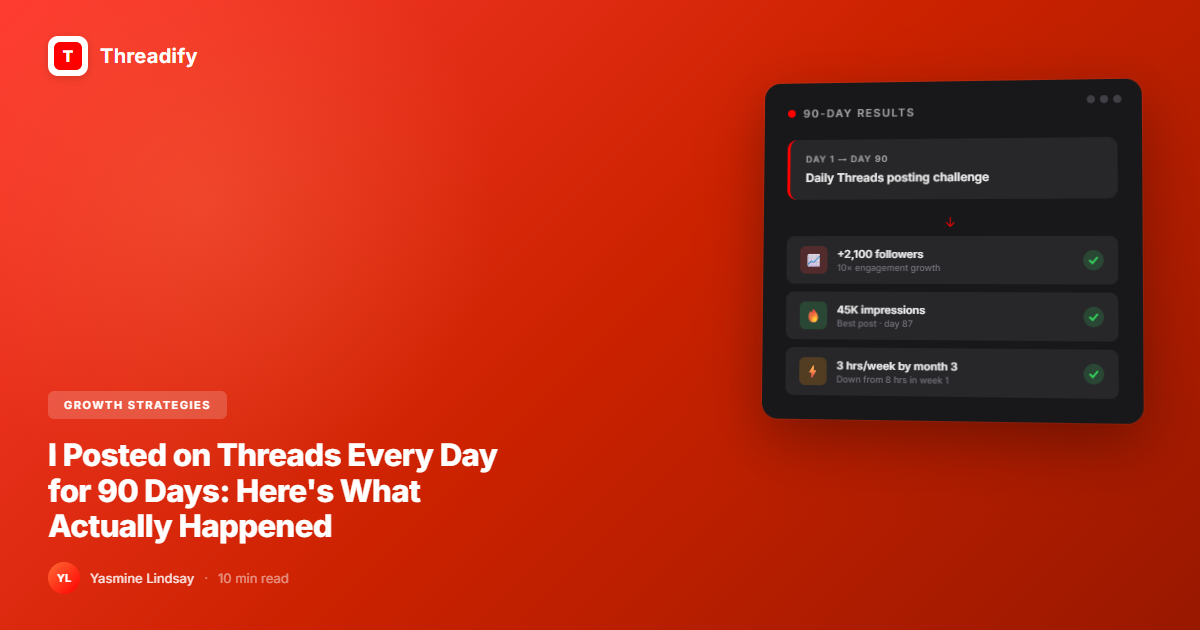
The final numbers:
- Total posts: 90
- Total new followers: ~2,100
- Final engagement average: 60-120 likes, 20-40 replies
- Highest performing post: 380 likes, 94 replies, ~45,000 impressions
- DMs received: 50+ (partnership offers, collaboration requests, genuine fan messages)
- Time per week: 3 hours (down from 8 in week 1)
What the final month felt like: Routine. Not boring. Routine in the way that a workout becomes automatic. I knew what to write, how to write it, and when to post it. The creative part was still creative. Everything else was systematised.
The Numbers People Actually Want to See
Let me lay out the month-by-month honestly:
- Month 1 (Days 1-30): ~250 new followers, 8 avg likes, 2 avg replies, 3,200 top impressions
- Month 2 (Days 31-60): ~650 new followers, 35 avg likes, 10 avg replies, 18,500 top impressions
- Month 3 (Days 61-90): ~1,200 new followers, 85 avg likes, 30 avg replies, 45,000 top impressions
The compound effect is real. Month 3 wasn't 3x better than month 1. It was ~5x better for followers, ~10x for engagement, and ~14x for reach.
And this isn't unusual. According to Buffer's 2026 State of Social Media report, Threads has a median engagement rate of 6.25% (compared to X's 3.6%), making it the highest-engagement major social platform for creators right now. The platform rewards consistency because consistent accounts feed the algorithm what it needs: reliable signals, topical coherence, and a viewer who keeps coming back.
But here's what the numbers don't show:
- The confidence I gained from knowing exactly what my audience wants
- The relationships I built with other creators through consistent engagement
- The content system I now own that works whether I'm inspired or exhausted
- The clarity about my niche that came from 90 data points, not guesswork
What I'd Do Differently
Start with replies, not posts
If I did it again, I'd spend the first week only replying to other people's posts. Zero original posts. Build relationships first, then start sharing.
Batch from day 1
I didn't start batch-writing until week 3. Those first 3 weeks of "write something fresh every morning" were unsustainable and stressful.
Score before publishing
The posts I scored (checking hook strength, clarity, engagement triggers) before publishing outperformed unscored posts by ~40%. I wish I'd done this from day 1 instead of day 30.
Track less, create more
I spent too much time in analytics the first month. Weekly reviews are enough. Daily analytics checking is just procrastination disguised as strategy.
The System That Made It Work
Here's exactly what my weekly system looked like by month 3:
Sunday (60-90 minutes):
- Review last week's top 3 and bottom 3 posts
- Write 7 draft posts for the week
- Score each one (hook, clarity, engagement trigger, voice check)
- Schedule all 7
Daily (15-20 minutes):
- Reply to 10+ posts in my niche
- Respond to comments on my post
- Save any ideas that come up during the day
Friday (15 minutes):
- Quick performance review
- Note any content ideas sparked by the week's conversations
- Update my swipe file with any standout posts (mine or others')
Monthly (30 minutes):
- Deep review of the month's data
- Update my Knowledge Base with new stories and milestones
- Adjust content mix if patterns have shifted
Total weekly commitment: ~4-5 hours for daily posting, daily engagement, and weekly strategy.
The scoring step is the one most people skip. I now run every post through Threadify's Viral Score before publishing. It checks hook strength, readability, and engagement triggers. Posts that score below 80 get rewritten. It sounds like extra work. It's actually the step that cut my "dead" posts by about half.
The Real Question
You're not reading this to see my numbers. You're reading it to decide if daily posting is worth your time.
Here's my honest answer: the first 30 days aren't worth it for the results. They're worth it for the system you build.
If you quit at day 30, you'll have some data and some followers. If you make it to day 90, you'll have a machine: a content system, a known voice, an engaged audience, and the creative confidence that comes from 90 reps.
The creators who "blow up" on Threads didn't get lucky. They posted through the dead zone long enough for compounding to do its thing.
You already have the ideas. You just need the reps.
Your Next Step
Don't commit to 90 days. That sounds overwhelming.
Commit to 7. One week of daily posting. Write your first post tonight. Batch-write the rest on Sunday. Schedule them. Show up for 7 days.
After 7 days, decide if you want to do 7 more.
That's how you get to 90. Not by staring at the finish line, but by running the next rep.
If you want the system that handles the scheduling, scoring, and batching so you can focus on the writing, Threadify is worth looking at. It's the Threads creator workspace I use to draft in my voice, score before posting, and auto-publish my weekly queue.
Related reads:
Related reading: Grow a niche Threads audience without burnout · How to grow on Threads as a beginner · Build a Threads content system that runs without you
Frequently Asked Questions
How long does it take to see results from daily posting on Threads?+
The first 30 days show minimal results — you're building the foundation. Real momentum starts around day 40-50 when the algorithm has learned your topics and your audience recognises your voice. By day 90, engagement and reach typically compound 5-10x compared to month one.
Is posting on Threads every day worth it?+
Yes, but not for the reasons most people think. Daily posting for 90 days isn't about going viral — it's about building a sustainable content system, understanding your audience through data, and developing creative confidence through reps. The first 30 days build the system. The next 60 reap the compound effect.
How many followers can I gain from 90 days of daily Threads posting?+
Results vary by niche and content quality, but consistent daily posting with strategic engagement typically yields 1,000-3,000 new followers over 90 days. The bigger win isn't follower count — it's the engaged audience who actually know you and reply to your posts.
What's the best time to post on Threads?+
There's no universal best time. The algorithm prioritises reply velocity in the first 30-90 minutes over post timing. Post when you can immediately engage with replies, not when a chart says you should. Your specific audience's active hours matter more than generic advice.
How do I stay consistent posting on Threads every day?+
Batch-write 5-7 posts on Sunday, schedule them in advance, and spend 15 minutes daily engaging with other creators instead of writing fresh content every morning. Consistency comes from systems, not motivation. Separate content creation from content publishing.
Try Threadify for free
Write better Threads in less time. Generate, refine, schedule—without the chaos.