Score It Before You Post It: How Threadify Score Turns Good Drafts Into Viral-Ready Posts
Most creators hit publish and pray. The ones who grow consistently score their content first. Here's how Threadify Score turns good drafts into viral-ready posts.

Most creators hit publish and pray. The ones who grow consistently do something different: they score their content before it goes live. A pre-publish quality check catches weak hooks, vague messaging, and engagement killers before your audience ever sees them. This isn't about perfectionism. It's about removing the obvious mistakes that tank your reach.
Quick Steps
Write your draft without editing.
Run it through a scoring system (hook strength, clarity, engagement triggers).
Check: does the first line make someone stop scrolling?
Check: is there a reason to reply, save, or share?
Fix the weakest element first.
Score again. Publish when you're above your baseline.
The Publishing Prayer Problem
Here's what most creators do:
Write something. Stare at it. Convince themselves it's fine. Hit publish. Refresh 14 times. Get 3 likes. Feel defeated.
The post wasn't bad. It just wasn't ready.
And the frustrating part? The gap between "decent idea" and "viral-ready post" is usually one or two tweaks. A sharper hook. A clearer point. A line that invites a reply instead of a nod.
But you can't see those gaps when you're staring at your own draft. You need something outside your head to point at the weak spots.
That's what scoring does.
What is content scoring?
Content scoring is the practice of evaluating a post against measurable quality signals (hook strength, readability, engagement probability, emotional triggers) before publishing. It turns "I think this is good" into "I know this hits these benchmarks."
The 5 Signals That Predict Whether Your Post Will Land
Not all posts are created equal. Research across thousands of viral Threads posts reveals consistent patterns:
Signal 1: Hook Strength
The first line does 80% of the work. If it doesn't stop a scroll, nothing else matters.
Weak: "Here's what I learned about content creation this week." Strong: "I mass-deleted 47 scheduled posts yesterday. Here's why."
The strong hook creates a gap (why would someone delete their content?) that can only be closed by reading further. Our analysis of 500 viral Threads posts found that posts with strong hooks averaged 73% more engagement than those without.
Signal 2: Clarity of Point
Every post needs one clear takeaway. Not three. Not "a few thoughts." One.
Ask yourself: if someone screenshots this and sends it to a friend, what's the one sentence they'd highlight?
If you can't answer that, the post isn't ready.
Signal 3: Engagement Trigger
Does your post give people a reason to respond? On Threads, replies are weighted 3x higher than likes in the algorithm. The best triggers are:
Disagreement bait (a stance people want to argue with)
Completion prompts ("what's yours?")
Validation hooks (describing something people feel but haven't put into words)
Signal 4: Readability
Short sentences. White space. Rhythm changes.
Try Threadify for free
Write better Threads in less time. Generate, refine, schedule—without the chaos.
If your post looks like a paragraph from a textbook, it's dead on arrival. Mobile screens are small. Attention is smaller. The sweet spot for Threads is 40-120 words: enough to make a point, short enough to keep them reading.
Signal 5: Emotional Resonance
Data informs. Emotion moves. The posts that get shared aren't the most informative. They're the ones that make people feel seen.
"I've been posting for 6 months and sometimes I wonder if anyone even notices."
That line has zero tactical advice. But it gets saved, shared, and replied to because it's felt.
How Threadify Score Works
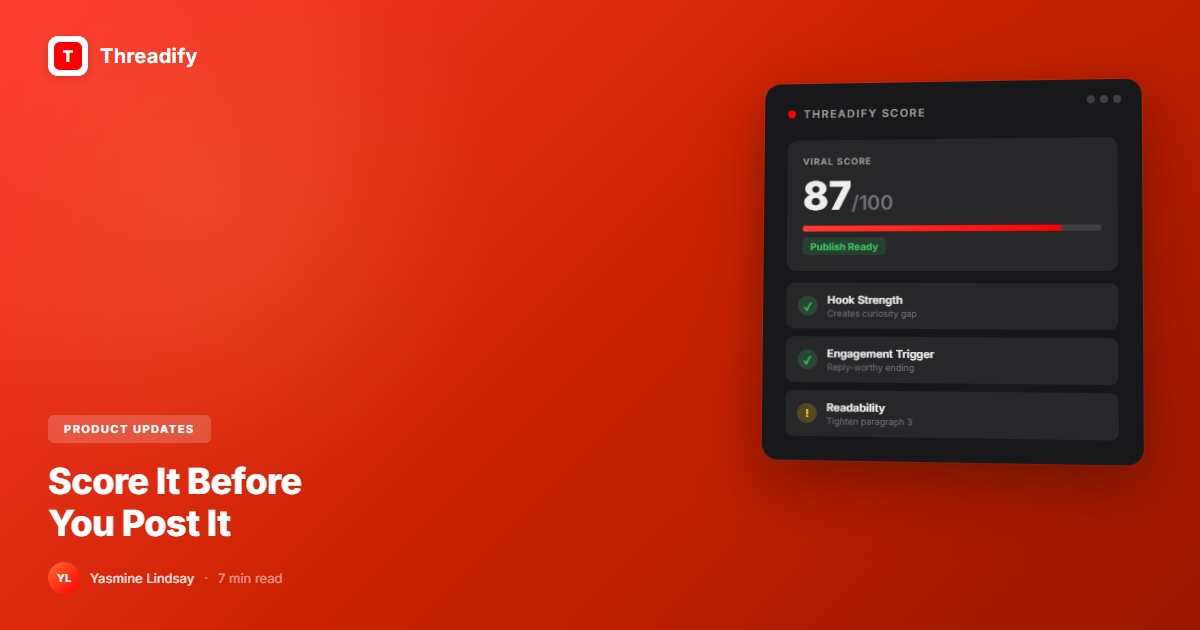
Threadify Score analyses your draft against the same signals that drive engagement on Threads:
Write your draft or paste it into the composer
Threadify Score gives you a Viral Score plus a Readability Check: instant breakdown of hook strength, clarity, and engagement prediction
See specific suggestions for what to fix
Tweak and re-score until you're in the green
The score tells you the truth before the algorithm does. It's not telling you what to write. It's telling you what's getting in the way of what you already wrote being great.
Before and after
Weak Hook: "5 tips for writing better Threads posts" (Score: 32/100, generic, forgettable, no tension)
Fixed Hook: "Your Threads posts aren't boring. They're just invisible. Here's the fix." (Score: 91/100, specific problem + promise of solution)
The difference isn't talent. It's editing with feedback.
How to Build a Pre-Publish Scoring Habit
You don't need to be a copywriting expert. You need a system.
Step 1: Write First, Score Second
Never score while writing. Drafting and editing use different parts of your brain. Write the messy version first. Get the idea out. Then switch modes. The Modular Thread Stack method works well here: draft one idea, then score each variation separately.
Step 2: Run the Checklist
Before publishing, run through these questions:
Does the first line create curiosity or tension?
Is there ONE clear point (not three)?
Would someone reply, save, or share this?
Is it scannable on mobile?
Does it sound like me (not a LinkedIn robot)?
Step 3: Fix the Weakest Link
You don't need to rewrite the whole thing. Find the single weakest element and fix that. Usually it's the hook. Sometimes it's the ending (no CTA, no reason to engage).
Step 4: Track Your Baseline
Over time, you'll notice a pattern. Posts that score above a certain threshold perform. Posts below it don't. That threshold is your publishing standard.
This isn't about chasing perfect scores. It's about establishing a minimum viable quality bar.
The "Good Enough" Trap
Some creators never publish because nothing feels "done."
Scoring actually fixes this. When you have an objective benchmark, you know when something is ready. You're not guessing. You're not asking your group chat. You're not refreshing your notes app at 2am wondering if the hook is strong enough.
Green score, publish. Done.
Perfectionism thrives on ambiguity. Scoring kills ambiguity.
Why This Matters More Now
With AI-generated content flooding every platform, the algorithm is getting better at filtering out low-effort posts. Google's March 2026 Core Update cracked down on thin AI content, explicitly rewarding experience-driven, original-insight writing with stronger E-E-A-T signals. Threads is doing the same: rewarding original voices and real conversations, burying cookie-cutter posts.
Scoring your content isn't just about vanity metrics. It's about making sure your voice actually cuts through the noise. The creators building a Knowledge Base and scoring before they publish are the ones whose content still sounds human. That matters.
Your Next Step
You have drafts sitting in your notes app right now that are one tweak away from landing.
Don't rewrite them. Score them. Fix the weakest signal. Publish.
Threadify Score is built into the workspace. Write your draft, score it, and know exactly what to fix before you post. No guessing. No praying. Just data.
Try scoring your next post with Threadify
Related reads:
How to get more followers on Threads: growth tactics that compound
We analysed 500 viral Threads posts: the structural DNA of posts that break through
The Modular Thread Stack: build 3 pieces of content from 1 idea
AI Slop Is a Choice: keep your voice while scaling with AI
Frequently Asked Questions
What is the Threadify Score?+
The Threadify Score evaluates your Threads draft against measurable quality signals including hook strength, readability, and engagement probability. It gives you a Viral Score and Readability Check before you publish.
How do I score my Threads post before publishing?+
Write your draft in Threadify, then run it through Threadify Score. It shows your Viral Score and a Readability Check with specific suggestions for what to fix before hitting publish.
What makes a Threads post go viral?+
Viral Threads posts consistently score high on five signals: hook strength, clarity of point, an engagement trigger (reason to reply), readability on mobile, and emotional resonance.
Does content scoring work for short posts?+
Yes. Threadify Score works for any length. For posts under 120 words, hook strength and clarity are the most important signals. The tool scores what you give it regardless of word count.
What score should I aim for before publishing on Threads?+
Track your personal baseline over time. Most creators find that posts scoring 70+ correlate with above-average engagement. Your threshold will shift as you improve your content quality.
Try Threadify for free
Write better Threads in less time. Generate, refine, schedule—without the chaos.