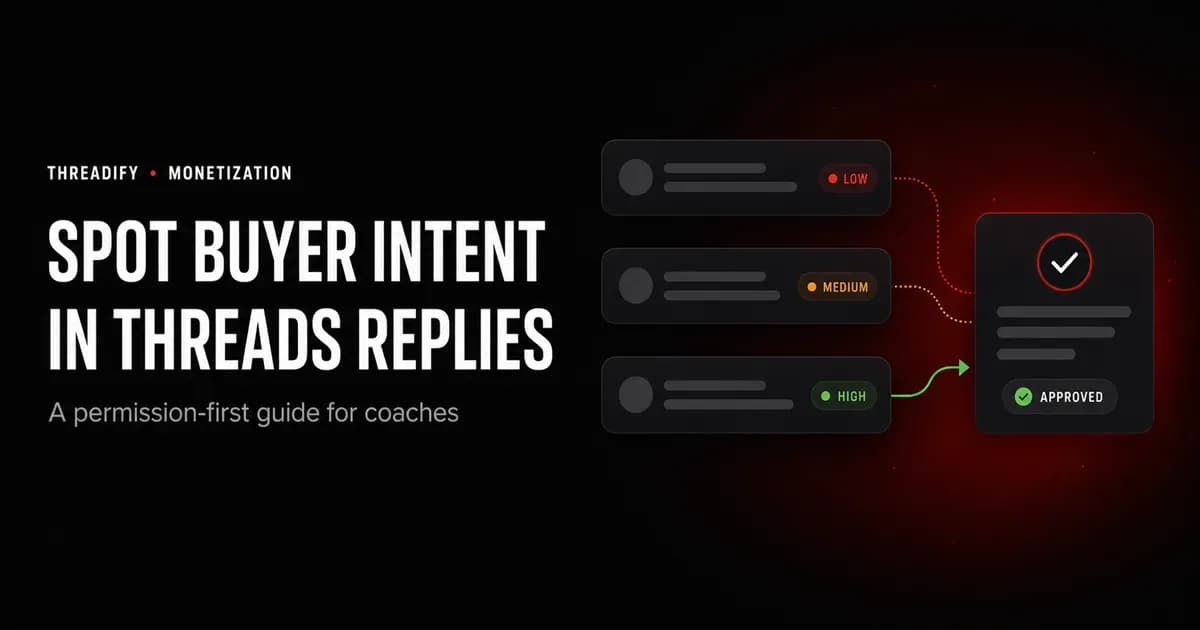
How Coaches Can Spot Buyer Intent in Threads Replies (Without DMing Everyone)
Not every Threads reply is a lead. This red, amber, and green method helps coaches spot likely buyer intent and choose a human next step.

How Coaches Can Spot Buyer Intent in Threads Replies (Without DMing Everyone)
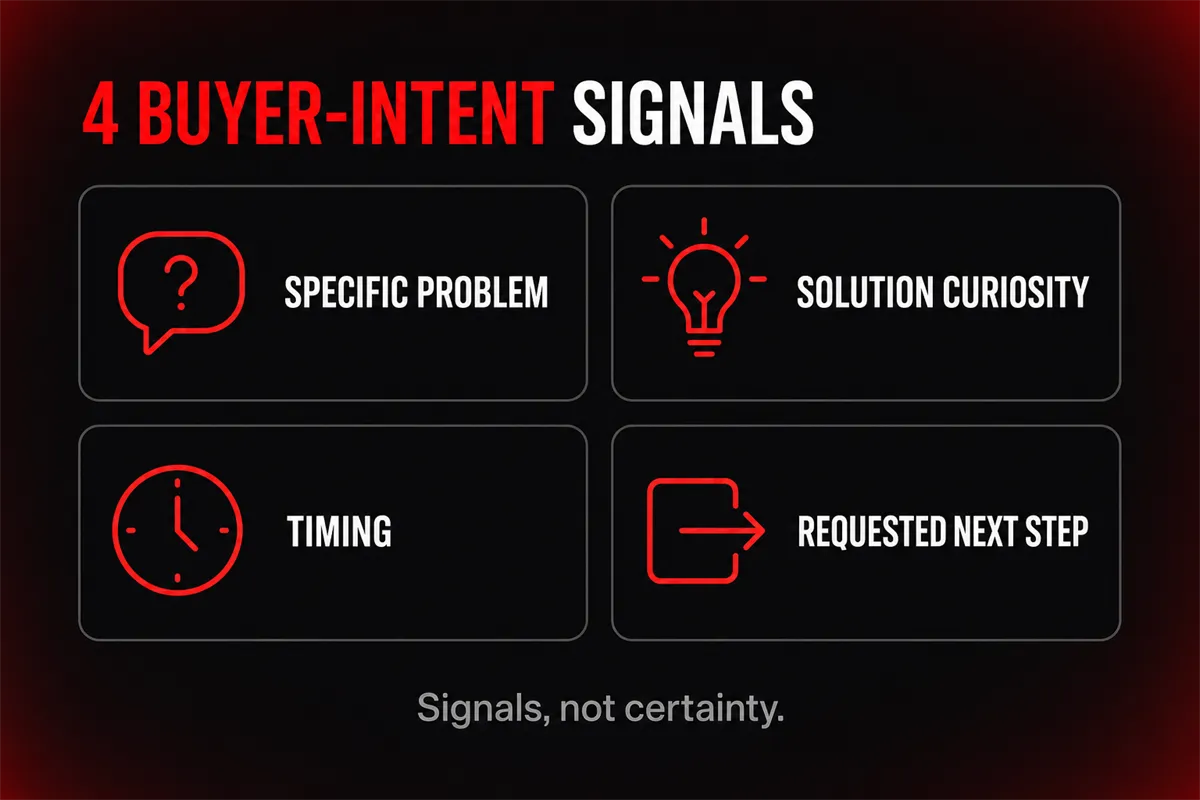
To spot buyer intent in a Threads reply, look for four things: a specific problem, curiosity about your solution, a reason the problem matters now, or an explicit request for a next step.
Treat those as signals, not certainty.
Respond helpfully in public first. Then ask permission before moving to a DM. That is the difference between noticing a possible client and turning every person who comments into a sales target.
Not every reply is a lead
Someone saying “love this” is engagement.
Someone saying “this is exactly what keeps happening with my clients, and I need to fix it before our next launch” is different.
The second reply gives you context. There is a real problem, a consequence, and a reason it matters now. It deserves more attention.
It still does not prove the person wants to buy from you.
That distinction matters for coaches and consultants because your work is built on trust. If every reply triggers a pitch, people learn that talking to you comes with a hidden sales sequence attached.
The goal is not to label people as leads as fast as possible. The goal is to notice when a conversation may deserve a thoughtful next step.
The four buyer-intent signals to look for
1. Problem specificity
Generic replies are easy to agree with:
“Marketing is so hard.”
A specific reply tells you what is actually happening:
“I can get people onto discovery calls, but most of them are not ready to decide.”
Specificity can show up as:
a situation they keep repeating,
a failed attempt,
a cost in time, money, energy, or confidence,
a constraint they cannot work around,
an outcome they want but have not reached.
The more concrete the problem, the easier it is to respond usefully.
2. Solution curiosity
Some people do not ask, “Can I hire you?” They ask how you think.
They might say:
“How would you handle this?”
“Is this something you help clients with?”
“What does your process look like?”
“Would this work for a small team?”
That curiosity is not a buying decision. It is a sign that your method may be relevant to a problem they already recognise.
Answer the question before trying to move the conversation.
3. Timing
A problem becomes more urgent when something creates a deadline.
Look for language such as:
“before our launch,”
“this quarter,”
“I have a call next week,”
“we are hiring,”
“I need to decide soon,”
“I cannot keep doing this for another month.”
Timing does not mean you should manufacture urgency. It means the reader has already told you why the issue matters now.
4. Permission or next-step language
The clearest signal is when someone asks for a next step:
a guide,
a link,
your pricing,
a call,
a DM,
more detail about working together.
When the request is explicit, honour the exact request. Do not turn “Can you send the checklist?” into a ten-message sales interrogation.
Give them what they asked for. Then let the conversation earn its next step.
Use a red, amber, and green reply filter
You do not need a complicated lead score. Start with three labels.

Red: ordinary engagement
Examples:
“Love this.”
“So true.”
a joke, reaction, or emoji,
a broad opinion with no personal context.
What to do: reply like a person. Continue the public conversation if you have something genuine to add.
What not to do: send an unsolicited sales DM.
Amber: a possible problem signal
Examples:
a specific challenge,
a thoughtful objection,
a question about your approach,
Try Threadify for free
Write better Threads in less time. Generate, refine, schedule—without the chaos.
a failed attempt with no requested next step.
What to do: ask one useful public question or give a short answer.
For example:
“When you say the calls are not converting, where do they usually stall?”
You are trying to understand, not corner them.
Green: an explicit or time-sensitive next step
Examples:
“Do you work with people on this?”
“Can you send me the details?”
“I need help before our launch next month.”
“Would you be open to chatting?”
What to do: answer clearly and ask permission for the next channel.
For example:
“Yes, this is part of my consulting work. I can send you the short overview if you want. Would a DM be easiest?”
Green does not mean “close the sale.” It means the person has given you a clear reason to continue.
The five-step permission-first workflow

Step 1: Capture the evidence line
Save the exact part of the reply that caught your attention.
Not their entire profile. Not a paragraph of assumptions about them.
Just the evidence:
“I keep attracting calls with people who cannot afford the offer.”
This keeps your interpretation tied to what the person actually said.
Step 2: Name why it may matter
Choose the signal you saw:
specific problem,
solution curiosity,
timing,
requested next step.
If you cannot name the signal, it may be ordinary engagement.
Step 3: Respond usefully in public
Give value before you ask for movement.
Answer the question. Clarify the problem. Ask one relevant follow-up.
This gives the person a safe way to continue, leave, or correct your interpretation.
Step 4: Ask permission before moving privately
Use a small, easy question:
“Want me to send the framework?”
“Would a DM be useful?”
“Do you want the details here or privately?”
Permission is not friction. It protects the relationship.
Step 5: Record the next step and outcome
Most creators remember the exciting conversations and forget the rest.
Record:
the original signal,
what you sent,
the agreed next step,
whether anything happened.
Without that receipt, you cannot tell which Threads conversations create clients and which ones only felt promising.
Three illustrative reply examples
These examples are fictional. They show the method, not customer results.
Example 1: Engagement, not intent
Reply:
“Needed this today.”
Response:
“Glad it found you at the right time. Which part landed?”
Why: there is no reason to pitch. A genuine public question is enough.
Example 2: Amber signal
Reply:
“I have plenty of enquiries, but people disappear as soon as I send the proposal.”
Response:
“That is a frustrating place to lose them. Do they usually disappear before discussing the price, or after they see it?”
Why: the problem is specific, but the person has not asked for your service. Help clarify the bottleneck first.
Example 3: Green signal
Reply:
“This is exactly what is happening in my consultancy. Do you help people fix this?”
Response:
“Yes, this is part of the work I do. I can send you a short explanation of the process. Would you like it here or by DM?”
Why: the person asked directly. The response answers them and gives control over the next step.
When not to move to a DM
Do not move the conversation privately just because:
the person follows you,
they praised your thread,
their profile looks like your ideal client,
they mentioned a problem once,
you have a resource that could technically help.
Stay public when the topic is sensitive, the person has not invited more contact, or you do not have a genuinely useful next step.
You are allowed to let a good conversation be a good conversation.
A one-minute reply-triage checklist
Before treating a reply as a possible buyer signal, ask:
What did they actually say?
Is the problem specific?
Are they curious about a solution?
Is there a real timing signal?
Did they ask for a next step?
What useful public response can I give first?
Have I asked permission before moving privately?
How will I record what happens?
If you cannot answer the first five questions, do not invent intent.
Where Threadify fits
You can run this workflow manually with bookmarks and a small spreadsheet.
Threadify is useful when the volume becomes hard to hold in your head. It helps turn a buyer signal into a reviewable lead card, prepare an in-voice follow-up for your approval, and keep a receipt of the next step.
The agent drafts. You decide whether to edit, send, or skip.
That is the point: notice more without giving a bot ownership of the relationship.
For the broader acquisition loop, read Threads Lead Generation: How to Turn Threads Attention Into Customers. If the reply should become your next thread rather than a sales conversation, use the reply-to-content loop.
Frequently asked questions
What counts as buyer intent in a Threads reply?
Buyer intent is a sign that someone may be exploring a solution, not proof that they will buy. Useful signals include a specific problem, curiosity about your method, a reason the problem matters now, or an explicit request for a next step.
Should I DM everyone who asks a question?
No. Answer publicly when you can. If a private next step would genuinely help, ask permission first.
What should I say before moving to a DM?
Keep it simple: “I can send you the framework if that would help. Would you prefer it here or by DM?” The person can choose the channel or decline.
Can this work if I have a small Threads audience?
The method does not require a large audience. It requires relevant conversations. A small number of specific replies can be more useful than a large number of generic reactions.
Do I need software to track reply signals?
No. Start with bookmarks and a simple note or spreadsheet. Use a tool when reviewing, following up, and recording outcomes becomes difficult to manage consistently.
Your next step
Open the replies on your five most recent Threads.
Find one specific problem, one solution question, and one explicit next-step request. Label each red, amber, or green. Then write the most useful public response before you think about a DM.
If you want a reviewable system for capturing buyer signals, approving follow-up, and tracking what happens next, try Threadify free for 7 days.
You keep final say.
Frequently Asked Questions
What counts as buyer intent in a Threads reply?+
Buyer intent is a sign that someone may be exploring a solution, not proof that they will buy. Useful signals include a specific problem, curiosity about your method, a reason the problem matters now, or an explicit request for a next step.
Should I DM everyone who asks a question?+
No. Answer publicly when you can. If a private next step would genuinely help, ask permission first.
Try Threadify for free
Write better Threads in less time. Generate, refine, schedule—without the chaos.