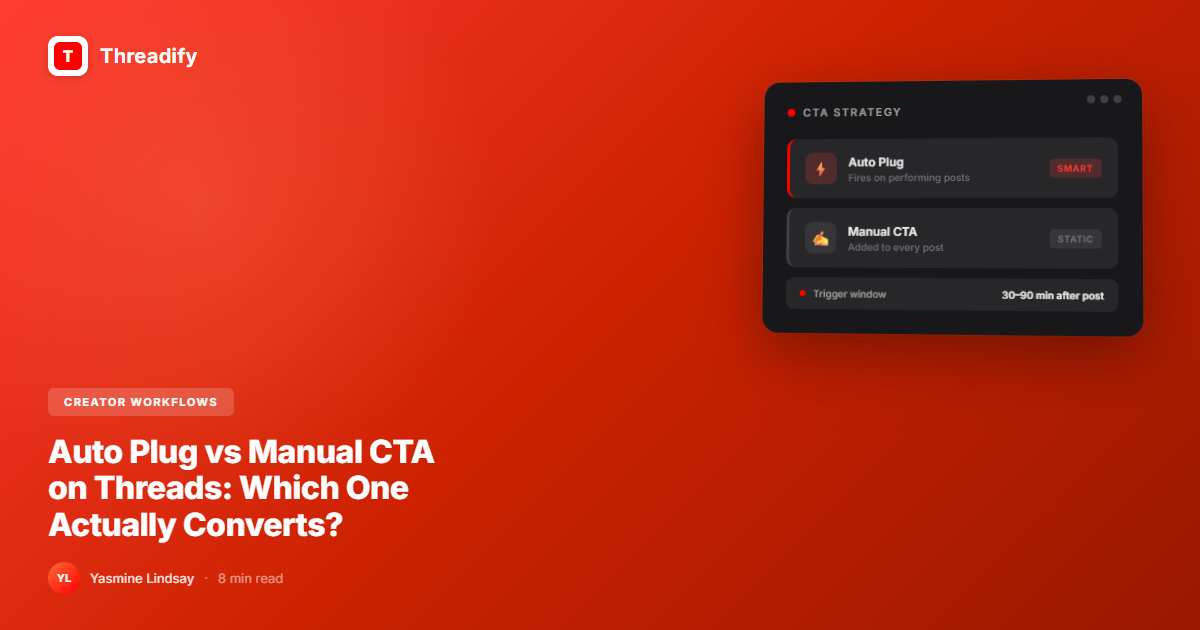
Auto Plug vs Manual CTA on Threads: Which One Actually Converts?
Most creators post a CTA at the end of every thread. Most creators' CTAs get ignored. Here's the actual difference between a manual CTA and Auto Plug, and when each one works.

Auto Plug vs Manual CTA on Threads: Which One Actually Converts?
Most creators add a CTA to the bottom of every thread. The follow ask, the link in bio prompt, the "drop a comment if this helped." Most of those CTAs get scrolled past. Some of them actively hurt reach.
The uncomfortable truth: a CTA that fires on every post is not a strategy. It's a habit dressed up as one.
There is a real difference between a manual CTA and a timed, automated one, and understanding it is the difference between a CTA that converts and one that disappears. (Before the CTA can do anything, the hook has to earn the read, but that's a separate problem.)
Manual CTA vs Auto Plug: The Real Difference
Before getting into tactics, here's what each one actually is:
Manual CTA: A call to action you write directly into the post, placed at the end of every thread regardless of how that post performs.
Auto Plug: A CTA that fires automatically as a comment reply, triggered when a post starts getting engagement. In Threadify, Auto Plug activates only when a post earns traction, so your conversion ask lands at the exact moment your audience is most active.
The core distinction is selectivity. Manual CTAs treat every post equally. Auto Plug treats posts the way the algorithm does: by performance.
Why Most Threads CTAs Get Ignored
Replying to your own Threads posts can boost engagement by up to 42%, according to Buffer. But this statistic comes with a caveat: the algorithm distinguishes effort. A genuine, specific reply earns weight. A templated "grab the link in my bio" earns nothing, and sometimes gets penalized.
Threads is built for conversation. The platform's ranking signals treat replies and thoughtful comments as quality indicators, while generic engagement bait, the "drop a fire emoji if you agree" style CTA, is explicitly deprioritized in Threads' distribution logic.
The first 30 to 90 minutes after posting is also the window that matters most. Early reply velocity is one of the strongest signals for broader distribution. A CTA that fires during this window on a post that's already gaining traction is doing something structurally different from a CTA pasted below a post that hasn't moved.
The Case for Manual CTAs
Manual CTAs are not broken. They are useful in a specific set of conditions.
A manual CTA works when the action flows directly from the content. A thread about your Threadify Knowledge Base setup earns a CTA pointing to Threadify. A thread about your email list earns a newsletter signup ask. The content teaches something and the CTA says: here is where to take the next step.
Manual CTAs also work when you are writing a post specifically designed to convert, rather than one designed to inform or build an audience. If the whole thread is positioned around a decision, the CTA belongs there from the start.
Where manual CTAs break down:
When they are pasted below every post regardless of intent
When the ask is generic ("follow for more content like this")
When the post is performing and you miss the window to follow up
When you are writing awareness content but your CTA sounds like you're pitching
The mistake is not the CTA itself. It is the assumption that every post deserves a pitch.
Try Threadify for free
Write better Threads in less time. Generate, refine, schedule—without the chaos.
The Case for Auto Plug
Auto Plug inverts the logic. Instead of asking on every post, it asks on the right posts at the right time.
The setup is simple: you write your CTA once in Threadify's CTA Studio, name the offer, and set the trigger conditions. When a post starts performing, Auto Plug drops the CTA as a comment. Your audience is already engaged with the content. The CTA arrives as a natural continuation, not a hard pivot.
This matters for two reasons.
First, it is selective. Auto Plug does not waste a conversion ask on a post that hasn't earned an audience yet. Every CTA is working with momentum rather than against cold air.
Second, the timing is built into the algorithm's behavior. The first 30 to 90 minutes after a post breaks out are when your replies carry the most weight. A CTA that fires in that window, on a post that is already getting replies, benefits from the engagement stack. The reply itself adds to the post's score.
The result is a CTA that behaves less like an advertisement and more like a natural next step in a conversation that is already happening.
How to Know Which One to Use
Use a manual CTA when:
The thread is explicitly about solving a problem your product solves
You are writing a conversion-first post, not an awareness post
The CTA is so specific to the content that removing it would leave the post feeling incomplete
You have tested the post type before and the CTA historically performs
Use Auto Plug when:
You are writing awareness or education content where a pitch would feel out of place
You want your CTA to appear only on posts that are already gaining traction
You are posting consistently and do not have time to monitor each post for the right engagement window
You have a standing offer (trial, community, feature) you want available without repeating it manually
For most creators posting consistently, the answer is both, but not on the same posts. Awareness content earns Auto Plug. Conversion content earns a manual CTA. The goal is a content system where each post knows its job, and the CTA matches it.
If you are not sure what your posts' jobs are yet, the Threadify Score helps: it grades each draft before you post, so you know whether a post is going to earn reach or sit flat. Use that signal to decide whether to trust Auto Plug or write the CTA in manually.
Building a CTA System That Works
The creators who convert consistently are not the ones who have better CTAs. They are the ones who have a system for when to use which CTA.
Here is the version that works:
Write the post with one job in mind. Awareness, education, conversion, or community. Not all four.
Match the CTA to the job. If the job is awareness, let Auto Plug handle it. If the job is conversion, write the CTA in.
Keep the ask singular. One action per post. A CTA with two asks gets zero.
Tie the ask to the content. "I built a Threads content system using Threadify's Auto Plug feature" earns "try it here." A thread about how to write hooks does not earn "sign up for my course" in the last line.
The Threadify content system framework covers how to structure this at scale, but the CTA logic is the same whether you're writing five posts a week or fifty.
The Bottom Line
Manual CTAs are not bad. Auto Plug is not a shortcut. They are two different tools for two different moments in the posting cycle.
The habit of adding a CTA to every post is not a strategy. But the habit of knowing when your audience is ready to be asked, and having a system that does the asking at that exact moment, is.
Threadify's Auto Plug handles the timing side. Your job is to write the post worth promoting.
If you're already on Threadify, set Auto Plug up once and let it run. If you're not, the Founder plan includes it at $99/month. Your best posts are doing the work. Auto Plug makes sure they're also doing the selling.
Frequently Asked Questions
What is the difference between a manual CTA and Auto Plug on Threads?+
A manual CTA is a call to action you write at the bottom of every post, regardless of how it performs. Auto Plug is a Threadify feature that automatically drops a CTA comment on your posts once they start gaining traction. The key difference is timing and selectivity: Auto Plug fires on posts that are already performing, when your audience is most engaged.
Does replying to your own Threads posts boost engagement?+
Yes. According to Buffer, replying to your own Threads comments can boost engagement by up to 42%. The Threads algorithm weights replies above likes as a quality signal, especially in the critical first 30 to 90 minutes after posting.
What is Auto Plug in Threadify?+
Auto Plug is a Threadify feature that monitors your Threads posts and automatically drops a pre-written CTA as a reply comment when a post starts gaining engagement. Instead of plastering every post with a CTA, Auto Plug activates only when a post earns it.
When should I use a manual CTA on Threads?+
Use a manual CTA when you have one clear, specific action tied directly to the post's content. For example, a thread about your newsletter earns a manual CTA pointing to the newsletter. If the action doesn't flow naturally from the content, skip it.
Do CTAs hurt reach on Threads?+
Generic CTAs like 'follow for more' or 'like and comment' can suppress reach. The Threads algorithm is designed to detect low-effort engagement bait and reduce its distribution. Specific, relevant CTAs that extend the conversation naturally tend to perform better.
Try Threadify for free
Write better Threads in less time. Generate, refine, schedule—without the chaos.