How to Write a Hook That Stops the Scroll on Threads (With Examples)
Your hook is the only line that matters until it works. Here's how to write Threads hooks that earn the scroll â 12 archetypes, real examples, and the technical specs top creators use.

Most creators treat their hook like the introduction to an essay.
It's not. It's a toll booth. The algorithm checks your hook and decides whether to let the post through. Your reader checks it and decides whether you're worth 30 seconds of their time.
The hook is the only line that matters until it works.
How to write a Threads hook that stops the scroll
A hook that works does five things in under 150 characters:
Lead with a specific number or personal pronoun â "I", "You", or a number in the first five words. Numbers make the promise concrete. Pronouns make it personal.
End with a colon or ellipsis â both are expansion signals. They train readers to expect more.
Open two loops at once â a story loop (what happened?) and a value loop (what will I learn?). One loop gets curiosity. Two loops get commitment.
Match the hook archetype to your content type â there are 12 proven archetypes. Using the wrong one for your content is like putting a celebration graphic on a post about what went wrong.
Stay under 150 characters â short-form hooks perform best between 101-150 characters. Long-form thread hooks can go to 200.
What a hook is, exactly: The first 1-2 sentences of a Threads post that determine whether a reader stops scrolling or keeps going. A good hook opens a specific loop (either a story gap or a knowledge gap), makes a concrete promise, and forces a decision: read or scroll. According to MomentumHive's 2026 Threads algorithm analysis, Threads tracks read-through rate as a distribution signal â posts that lose readers in the first line get limited reach regardless of content quality. The hook decides whether your post exists at all.
The 12 hook archetypes (with examples)
These aren't formulas. They're patterns from thousands of high-performing Threads posts. Match the archetype to what you're actually saying.
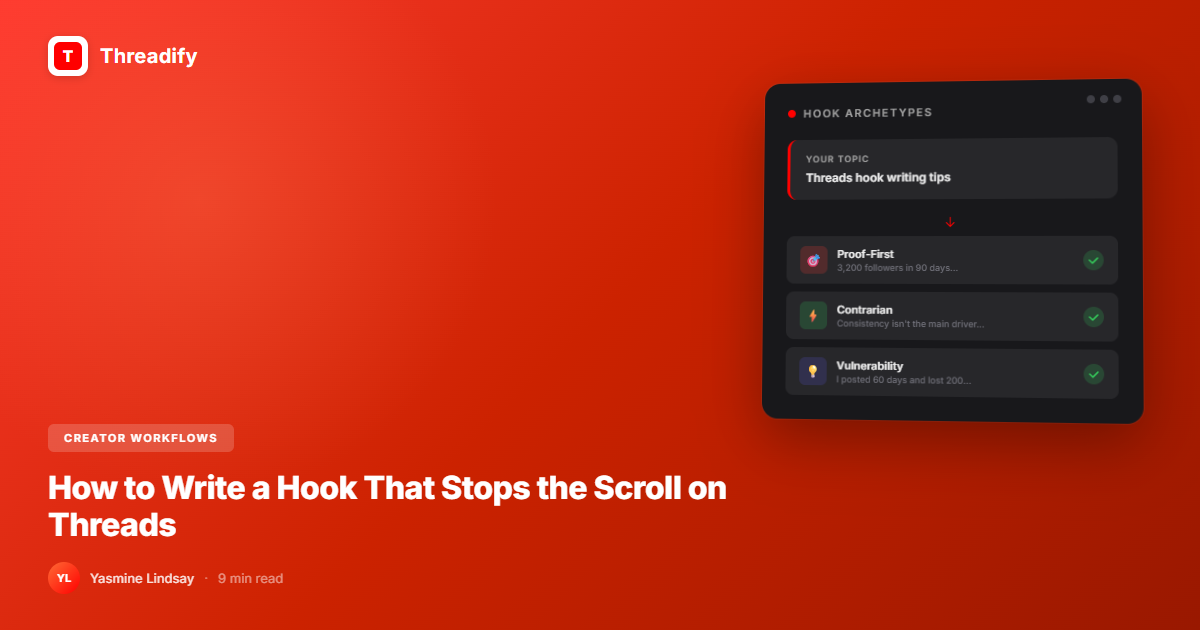
1. Proof-First Format: [Metric] in [timeframe]. Here's the [non-obvious factor]. Example: 3,200 new followers in 90 days. The hook was the only variable that changed. Use when: you have a real result and the "how" is what readers will stop for.
2. Contrarian Format: [Common belief] is wrong. Here's what [data] shows. Example: Consistency isn't the main Threads growth driver. Here's what actually is. Use when: you can back up the contrarian claim. Empty contrarianism gets scrolled past.
3. Vulnerability Format: I [failed/lost]. Here's what I learned. Example: I posted every day for 60 days and lost 200 followers. Here's what I changed. Use when: the failure is real and the lesson is concrete. Vague vulnerability reads as performance.
4. Pattern Recognition Format: I analyzed [N] of [thing]. Only [N] had [pattern]. Example: I analyzed 200 Threads posts from the last 30 days. Only 12 had hooks that followed this structure. Use when: you've actually done the analysis. Fabricated data gets called out.
5. Timeline Collapse Format: [Time] ago: [State A]. Now: [State B]. The turning point: Example: 6 months ago: 340 followers. Now: 18,000. The turning point was one small decision. Use when: the journey had a specific inflection point, not just "I kept going."
6. Diagnostic Question Format: Can you [action] without [reference]? If not, [implication]. Example: Can you write a Threads hook without looking at examples first? If not, here's what's missing. Use when: the question exposes a gap the reader didn't know they had.
7. Comparative Format: Everyone does [A]. Top performers do [B]. Example: Everyone writes their hook last. Top-performing Threads creators write it first. Use when: the comparison is genuinely true and the B behavior is non-obvious.
8. Myth-Busting Format: Myth: [false]. Reality: [truth]. Proof: [evidence]. Example: Myth: longer posts always perform better. Reality: the hook determines whether length matters at all. Use when: you have the evidence ready, not just the opinion.
9. Process Reveal Format: Here's exactly how I [result]. Step-by-step. Example: Here's exactly how I write 5 hooks in 10 minutes and publish the best one. Step-by-step. Use when: the process is genuinely yours, not a generic system you Googled.
Try Threadify for free
Write better Threads in less time. Generate, refine, schedule—without the chaos.
10. Prediction Format: I bet [prediction]. If I'm right, [implication]. Example: I bet you've never tested two hook versions for the same post. If I'm right, your data is lying to you. Use when: the prediction is edgy enough to create friction. Safe predictions don't perform.
11. Resource Hook Format: Here is [specific framework] for [specific outcome], for free. Example: Here are 12 hook archetypes for Threads, organized by content type. Save this. Use when: you're delivering something concrete and complete that stands alone.
12. Stakes Declaration Format: I'm [committing to action]. Track me. Example: I'm testing every hook archetype for 30 days and publishing the results. Track me. Use when: you'll actually follow through. Public commitments you don't keep destroy trust faster than bad hooks.
The engagement data on hooks
Hooks aren't created equal. Analysis of top-performing Threads content shows specific hook characteristics produce measurable differences:
Specific numbers in the first line: +42% engagement
Personal pronouns in the opening: +39% engagement
Contrarian framing: +65% share rate
Vulnerability framing: +60% save rate
Question format: +28% comment rate
The takeaway isn't "use all of these at once." It's that the highest performers are specific, not vague â and they commit to an angle instead of hedging.
The technical specs (non-negotiable)
A hook that follows good patterns but breaks these rules still underperforms:
First 5 words: must include a number or "I"/"You"
Character count: 101-150 chars for short posts, 150-200 for threads
End signal: colon or ellipsis (not a period, not nothing)
Each sentence on its own line: blocks of text on Threads kill read-through
Reading level: 5th grade max â complexity kills velocity
No trigger phrases: "buy now," "guaranteed," "limited time," "secret" â these are algorithm safety flags and suppress distribution before your audience even sees the post
How to score your hook before you publish
The lazy way to check a hook: does it make you want to read the next sentence?
The actual way: run it through the Threadify Score. Before you publish, the Score gives you two signals â a viral assessment and a readability check. Weak hooks show up in the viral score before the algorithm confirms it.
If your hook consistently scores below 7.5, the body content isn't the problem. The Score catches hook issues before the post goes live â not two days later when you're trying to figure out why reach was flat. Here's how the Threadify Score works and how to read it.
What most creators do wrong
They write the hook last.
The hook is the most important sentence in the post. Writing it last means it gets whatever creative energy is left after the body is done. That's the wrong allocation.
Try this: write three hook options before writing the body. Pick the strongest one. Build the body to fulfill what the hook promised.
The second mistake is generic hooks. "Sharing my thoughts on content creation" is not a hook. It's a disclaimer. Hooks make a specific promise and open a specific loop. If your hook could apply to any post by any creator on any platform, it's not a hook.
The third mistake is writing for your own taste instead of your reader's scroll velocity. Your hook isn't for you. It's for the reader at 9am who is deciding in 0.8 seconds whether to stop.
Building a hook habit
Hooks get better with reps, not inspiration.
Keep a swipe file of every hook that stops your scroll. Note which archetype it used. Over time you'll start seeing the patterns and writing them faster.
If you're batching content, write hooks first. Three to five versions per post. Then select. Then build the body. This is backwards from how most creators work, and it's part of why most creators have flat reach.
For more on building a consistent Threads content system, the batching guide covers the full workflow. For tracking which hook types actually perform for your account, the Threads analytics breakdown shows you how to read your own data â and what to do when the numbers surprise you.
Ready to test your hooks before they go live? Threadify's Score feature gives you algorithm feedback in under 10 seconds. No guessing.
Frequently Asked Questions
What makes a good Threads hook?+
A good Threads hook uses a specific number or personal pronoun in the first five words, ends with a colon or ellipsis, stays under 150 characters, and opens two loops — a story loop and a value loop. Generic hooks get scrolled past. Specific, unexpected ones don't.
How long should a Threads hook be?+
Between 101-150 characters for short-form posts, 150-200 for threads. Each sentence on its own line. The first five words are the most important — if those don't stop the thumb, nothing else matters.
What are the best hook types for Threads in 2026?+
The highest-performing hook archetypes on Threads in 2026 are: Contrarian (65% higher share rate), Proof-First with specific numbers (42% higher engagement), Vulnerability (60% higher save rate), and Pattern Recognition. Listicle hooks with a numbered promise also perform consistently well.
Why does my Threads content get ignored?+
Almost always the hook. If the first line doesn't earn a pause, the algorithm treats the post as low-interest and caps distribution. You can't fix reach problems with better body content — the hook is what gets the post seen at all.
Does the Threads algorithm care about the first line?+
Yes. Threads tracks read-through rate — whether users stop and read your full post or scroll past after the first line. Strong first-line performance in the first 30-90 minutes after posting is a primary signal for broader distribution.
Try Threadify for free
Write better Threads in less time. Generate, refine, schedule—without the chaos.