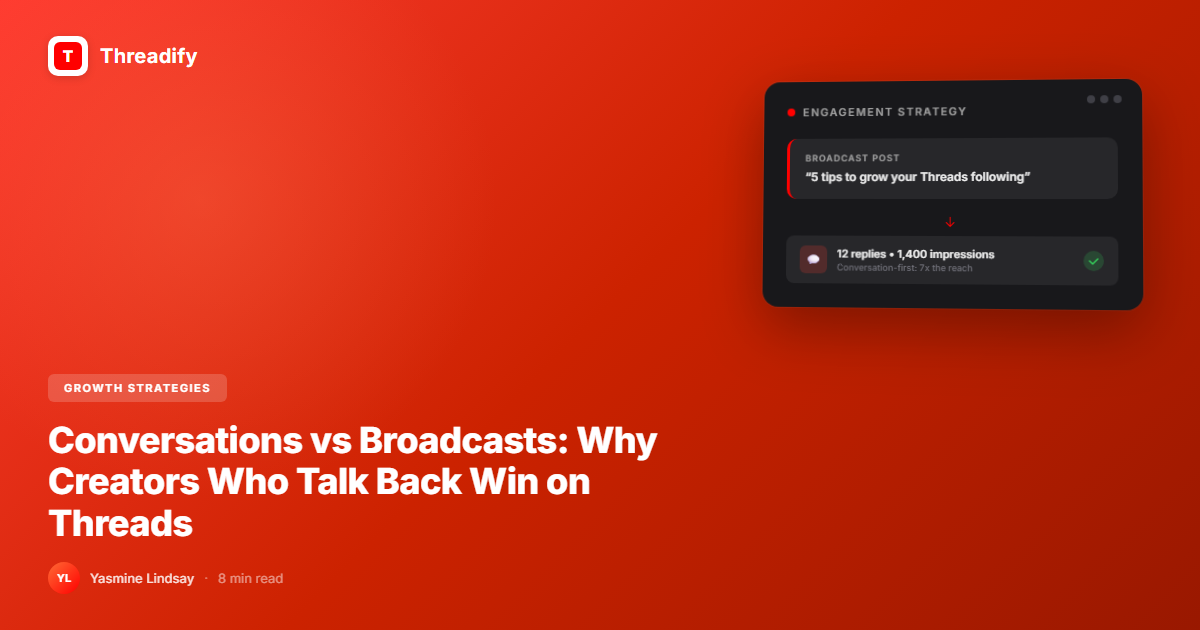
Conversations vs Broadcasts: Why the Creators Who Talk Back Win on Threads
Threads rewards conversations, not broadcasts. Learn why creators who talk back win, and how to restructure your content around dialogue instead of one-way announcements.

What is conversation-first content on Threads?
Threads is a conversation platform pretending to be a content platform. The creators winning aren't the ones with the most polished posts. They're the ones who treat every post as the start of a dialogue. Broadcast-style content (announcements, tips, one-way value) gets ignored. Content that invites response, challenges assumptions, or shares vulnerably gets amplified. According to MomentumHive's analysis of the Threads algorithm, replies carry significantly more weight than likes in determining reach. A post that sparks 10 real replies will outperform one with 100 hearts.
Quick Steps
Stop writing posts. Start writing conversation starters.
End every post with something worth responding to.
Reply to every comment in the first hour.
Use disagreement as content fuel (not as something to avoid).
Share process and struggle, not just results and tips.
Measure success by replies, not impressions.
The Broadcast Trap
Social media trained us to be broadcasters.
Write the perfect caption. Schedule it. Walk away. Count the likes.
That worked on Instagram in 2019. It worked on Twitter when reach was cheap. It even worked on LinkedIn when the algorithm rewarded any post with a pulse.
It does not work on Threads.
Threads was built on conversations. The algorithm surfaces content that generates replies, not passive engagement. A post with 10 thoughtful replies will outperform a post with 100 likes because replies signal that people actually care enough to type words back. MomentumHive's 2026 algorithm breakdown confirms that replies are the primary ranking signal, with the first 30-90 minutes after posting being the critical window.
And yet, most creators are still writing broadcasts.
"5 tips to grow your business." "Here's what I learned this week." "Excited to announce..."
These are announcements. They're one-directional. They don't give anyone a reason to respond beyond a heart emoji.
What is conversation-first content?
Conversation-first content is designed to provoke a response, not just deliver information. It prioritises dialogue over consumption. The post is the opening statement, not the final word. Success is measured by the quality and quantity of replies, not by impressions or likes.
The Shift: Audience → Community
The language matters.
An audience consumes. They watch, read, like, scroll. You are the performer. They are the spectators.
A community participates. They respond, challenge, share their own stories, build on your ideas. You are the conversation starter. They are co-creators.
Threads rewards community behaviour. The algorithm literally looks at reply chains and conversation depth to decide what to surface.
So the question isn't "what should I post?" It's "what should I start a conversation about?"
5 Conversation Structures That Outperform Broadcasts
1. The Vulnerable Admission
Share something you're struggling with or got wrong.
"I've been posting daily for 3 months and honestly? Some days I question if anyone cares."
Why it works: vulnerability is magnetic. People respond because they feel safe to share their own version of the same struggle.
2. The Hot Take
State an opinion that some people will disagree with.
Try Threadify for free
Write better Threads in less time. Generate, refine, schedule—without the chaos.
"Posting frequency matters more than post quality. Fight me."
Why it works: disagreement creates conversation. The key is having a real stance, not being contrarian for attention. You need to actually believe what you're saying.
3. The Question Post
Ask something specific enough to answer but open enough for variety.
"What's the one piece of advice you'd give your day-1 self on Threads?"
Why it works: people love sharing their experience. Specific questions get better answers than broad ones ("what do you think about social media?" = crickets).
4. The Shared Experience
Describe something hyper-specific that many people go through but nobody talks about.
"That moment when you check your analytics for the 7th time today and it's been 4 minutes since the last check."
Why it works: recognition is one of the most powerful emotions in social media. When someone reads something and thinks "that's literally me," they reply.
5. The Unfinished Thought
Start a thread and explicitly invite people to finish it.
"The hardest part of building in public isn't the building. It's..."
Why it works: you're creating a collaborative moment. People want to participate in something, not just witness it.
The Threadify Score Contrast
Weak Hook: "Here are 5 tips for better engagement on Threads" (Threadify Score: 30/100, broadcast format, generic, no reason to reply)
Fixed Hook: "I stopped giving 'tips' on Threads. My engagement tripled. Here's what I do instead." (Threadify Score: 92/100, counter-narrative, specific result, curiosity about the alternative)
The Conversation Flywheel
Here's what happens when you shift from broadcasting to conversing:
Week 1: You post a vulnerable thought instead of a tip. You get 3 replies instead of 15 likes. It feels like less engagement. It's not less engagement. It's deeper engagement.
Week 2: You reply to every response. Those people come back the next day. They bring friends. Your reply section gets richer.
Month 1: Your posts consistently generate conversations. The algorithm notices. Your reach expands, not to random people, but to people interested in the topics you discuss.
Month 3: You have a community. People tag you. They reference your conversations. You never run out of content ideas because your audience gives them to you.
This is the flywheel. Conversations generate engagement. Engagement generates reach. Reach brings new people into conversations. Repeat.
Why Creators Resist This (And Why It's Worth It)
Broadcasting feels safe. You write something polished, publish it, and your ego stays intact regardless of the response.
Conversing feels risky. You share something unfinished, take a real stance, or admit you don't have the answer. People might disagree. People might not respond at all.
But here's the truth: the creators who grow fastest on Threads are the ones willing to be wrong in public. They're willing to start a conversation they might not control. They're willing to say "I don't know. What do you think?"
That's not weakness. That's the whole game.
The Reply Rule
This is non-negotiable if you want conversations to work:
Reply to every comment in the first hour after posting.
Not a heart. Not a "thanks!" An actual response. Ask a follow-up question. Share a related thought. Build on what they said.
When people see that you actually reply, they start leaving better replies. When you ghost your comments section, people stop commenting. Simple.
What the data looks like in practice
Creators who shift from broadcast to conversation-first posting consistently report the same pattern: fewer likes, more replies, and significantly higher reach. The reason is simple. Likes are passive. Replies are active signals that tell the algorithm this content sparked something worth amplifying.
This aligns with what MomentumHive found in their Threads algorithm analysis: the algorithm treats replies as a strong signal of value, and actively surfaces content with reply chains over content with passive engagement. The implication for creators is that a post generating 10 real conversations is worth more than a post generating 100 hearts and no words.
Your Next Step
Look at your last post. Does it invite a response? Or does it just deliver information?
If it's a broadcast, rewrite the last line. Turn the statement into a question. Turn the advice into a confession. Turn the announcement into an invitation.
Then publish it. And reply to everyone who responds.
That's conversation-first content. And on Threads, it wins.
If you want to make those conversations easier to convert when a post takes off, Auto Plug drops your CTA into the reply section automatically when engagement spikes. Start a conversation, let Threadify handle the conversion.
Related reads:
10 Things to Put in Your Threadify Knowledge Base: make every draft sound like you
How to Write a Hook That Stops the Scroll on Threads: the structural DNA of high-performing posts
How to Get More Followers on Threads: proven tactics that actually work
Frequently Asked Questions
What is conversation-first content?+
Conversation-first content is designed to provoke a response, not just deliver information. It prioritizes dialogue over consumption, treats the post as an opening statement rather than a final word, and measures success by the quality and quantity of replies rather than likes or impressions.
Why do broadcasts fail on Threads?+
Broadcasts fail on Threads because the algorithm surfaces content that generates replies, not passive engagement. A post with 10 thoughtful replies will outperform a post with 100 likes because replies signal that people care enough to engage meaningfully. One-way announcements don't give people a reason to respond.
How do I start conversations on Threads instead of broadcasting?+
Start by rewriting your posts to invite dialogue. Share something vulnerable, ask a specific open-ended question, state an opinion people might disagree with, describe a shared experience, or create an unfinished thought that invites completion. Then reply to every comment in the first hour.
What's the difference between an audience and a community?+
An audience consumes passively — they watch, read, like, and scroll. A community participates actively — they respond, challenge, share their own stories, and build on your ideas. Threads rewards community behavior by amplifying posts with strong reply chains and conversation depth.
How long does it take to build a conversation-first community on Threads?+
Based on testing, Week 1 shows deeper but fewer replies, Week 2 builds returning participants, Month 1 generates consistent conversations that expand reach, and Month 3 creates a self-sustaining community where people tag you and reference your conversations. The key is replying to every comment in the first hour.
Try Threadify for free
Write better Threads in less time. Generate, refine, schedule—without the chaos.