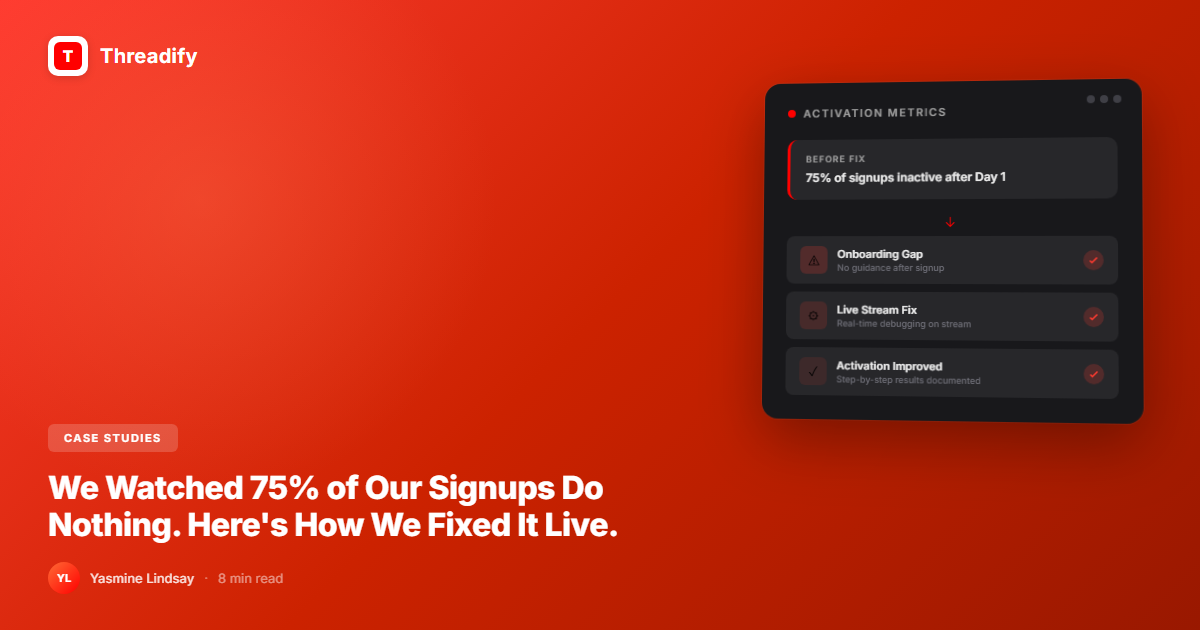
We Watched 75% of Our Signups Do Nothing — Here's How We Fixed It Live on Stream
555 users. 75 paying. A massive drop between signup and first post. Here's how Lenny diagnosed Threadify's activation problem live on stream — and built the fix with AI tools and community input in under an hour.

We Watched 75% of Our Signups Do Nothing — Here's How We Fixed It Live on Stream
Here's a number that should make any SaaS founder nauseous: 555 total users. 75 paying. And somewhere between the signup page and the first AI-generated thread, the majority of people just... vanished.
Not churned. Not complained. Didn't even get far enough to have an opinion. They signed up, looked around, and left before the product could prove itself.
What Is the SaaS Activation Problem?
The SaaS activation problem occurs when users sign up but never reach a product's core value — what growth teams call the "aha moment." A new user experiences the activation problem when the gap between signing up and experiencing that first moment of value is too wide, too confusing, or too slow. Without a clear path to value, most users leave before the product has a chance to prove itself.
The SaaS activation problem in one line: Users sign up because they understand your promise, but they never experience it — so they leave.
According to OpenView Partners' 2024 SaaS Benchmarks Report, improving activation is consistently ranked as the highest-ROI growth investment for product-led SaaS companies, outperforming increased acquisition spending. That's the lever most early-stage founders aren't pulling hard enough.
That's where we were on day 33 of building Threadify in public. And my co-founder Lenny ripped it open on a livestream — diagnosed it, designed the fix, and built it. Live. With viewers in the chat helping make decisions.
No scripted demo. No polished case study filmed three months after the fact. Just a non-technical founder staring at a leaky funnel and refusing to pretend it wasn't leaking.
The Activation Gap Nobody Talks About
Every SaaS founder obsesses over acquisition. How do I get more signups? How do I drive more traffic? What's my CAC?
Those are fine questions. They're also the wrong questions when your funnel has a gaping hole in the middle.
Here's what our numbers looked like at day 33:
$1,593 MRR across 75 active subscriptions at $39/month
555 total users signed up
A massive drop-off between "created account" and "generated first thread"
That drop-off is the activation gap. People signed up because they understood the promise — a workspace for Threads that handles content creation, scheduling, and analytics. But understanding the promise and experiencing it are two completely different things.
In SaaS, your product has maybe 90 seconds to deliver a moment of value before someone tabs over to the next thing. If your onboarding doesn't guide people to that moment fast enough, all the acquisition spending in the world won't save you. You're just pouring water into a bucket with no bottom.
Stop Telling AI How. Start Telling It What.
Here's where the stream got interesting.
Lenny needed to build a better onboarding flow — something that would walk new users through their first AI-generated thread. He's not an engineer. Samsam (our technical co-founder) handles the architecture. But this was a product decision wrapped in an implementation challenge, and Lenny wanted to tackle it himself.
So he opened up Codex — OpenAI's coding tool — and did something most people get wrong with AI: he told it what he wanted instead of how to do it.
No pseudo-code. No step-by-step instructions. No trying to be a pretend developer. He described the outcome: "I need an activation flow that gets new users to generate their first thread within 60 seconds of signing up."
Then he did the thing that separates people who get mediocre results from AI from people who get genuinely useful output: he asked the AI to ask him questions first.
Codex came back with 27 questions. Twenty-seven. About user personas, about existing onboarding steps, about what data we collect at signup, about edge cases. It was essentially conducting its own product discovery session.
Only after all 27 questions were answered did it produce a plan. And the plan was good — not because Codex is magic, but because it had actual context to work with instead of guessing.
Try Threadify for free
Write better Threads in less time. Generate, refine, schedule—without the chaos.
This is the paradigm shift I keep seeing with founders who use AI agents effectively. The ones who struggle are the ones who write detailed prompts trying to control every step. The ones who get results are the ones who define the destination and let the AI figure out the route — after gathering enough information to navigate.
Think about it like hiring. You don't tell a senior designer which pixels to move. You tell them the problem, the constraints, and the desired outcome. Then you get out of the way. Same principle applies to AI tools, except most people haven't made that mental shift yet.
Community Co-Design (Your Users Know Things You Don't)
The best part of the stream wasn't the AI tooling. It was the chat.
Karen, Moren, Ally, and other community members were watching Lenny build the activation fix in real time, and they started weighing in on product decisions:
Thread vs. post default: Should new users land on the thread composer or the single-post composer? The community had opinions, and they were different from what we assumed.
Knowledge base survey: We landed on a 3-question intake during onboarding — enough to seed the Knowledge Base so the AI doesn't sound generic from the very first generation.
Accessibility features: Viewers flagged considerations the team hadn't thought of.
This is community co-design, and I think it's massively underrated. Your most engaged users have context about their own workflows that no amount of analytics will reveal. They know what confused them during signup. They know which feature they almost didn't find. They know the exact moment the product clicked — or didn't.
When you build in public, you get that context for free. Not from a survey with a 4% response rate. Not from a user interview you scheduled three weeks from now. Live, in the moment, from people who care enough to watch you work.
If you're building anything for creators — and especially if you're building tools to help people create better content on Threads — your community is your product team. Treat them like it.
The AI Tool Spectrum (Pick Your Power Level)
Lenny demoed something during the stream that I think is genuinely useful for non-technical founders trying to figure out which AI tools to actually use.
He framed it as a spectrum:
ChatGPT (chatgpt.com) — The entry point. Good for brainstorming, writing, quick questions. Low power, low risk, low setup. If you've never used AI tools, start here.
Codex — The middle ground. It can write and execute code, troubleshoot problems, and even handle non-coding tasks like desktop cleanup and project organization. Lenny used it live to build the activation fix. You don't need to understand the code it writes — you need to understand the problem you're solving.
OpenClaw — The high end. Full computer access, multiple specialized agents, persistent memory, scheduled tasks. This is what runs Threadify's operations behind the scenes. More powerful, more setup, more responsibility.
The mistake most people make is jumping straight to the most powerful tool. That's like buying a commercial espresso machine when you've never made coffee. Start with ChatGPT. Graduate to Codex when you hit its limits. Move to OpenClaw when you need agents that work autonomously.
During the stream, Lenny's OpenClaw agent Clarity actually delivered a research packet mid-conversation — five minutes of autonomous research, packaged and presented without being asked. That's what the high end looks like. But you don't need that on day one.
The Repurpose Feature (Since We Showed It Off)
Lenny also demoed Threadify's repurpose flow during the stream, and it's worth mentioning because it connects directly to the activation problem.
The repurpose feature lets you take any piece of content — a blog post, a YouTube transcript, a podcast episode — and transform it into Threads-ready content. You can customize the instructions, add your own CTA, and the AI generates multiple variations you can edit, score before posting, and schedule.
The reason this matters for activation: we realized that many users who signed up didn't have a clear first action. "Write a thread" is vague. "Repurpose this YouTube video into three threads" is concrete. Specific entry points beat open-ended canvases every time.
It's the same principle behind the modular thread stack approach — give people building blocks, not blank pages. The content practically assembles itself when you start with source material and a clear structure.
Real Pressure, Real Timeline
I'll be direct about where we are because this is a building-in-public blog, not a highlight reel.
$1,593 MRR. The goal is $10K MRR by end of year. Lenny has said publicly — including on this stream — that it's either hit that target or go get a job. Those are the stakes.
That pressure is exactly why the activation fix matters so much. We don't have the luxury of a growth team running A/B tests for six months. We don't have a $50K monthly ad budget to compensate for a leaky funnel. Every signup that doesn't activate is revenue we can't afford to lose.
So when Lenny sits down on a livestream and builds the fix with AI tools and community input in real time, that's not a performance. That's survival. And I think there's something valuable in watching someone operate under that kind of constraint — it forces clarity about what actually matters.
The activation rate is what matters right now. Not new features. Not redesigns. Getting people from signup to first generation, fast, with enough personalization that the output doesn't feel like generic AI slop.
What This Means for You
You don't need to be building a SaaS for any of this to apply.
If you're a creator running your own content operation, the activation problem shows up everywhere. That course people bought but never started? Activation problem. The email list that gets opens but no clicks? Activation problem. The Threads account with followers who never engage? Activation problem.
The fix is always the same: identify the first moment of value, remove every obstacle between your user and that moment, and make the path so obvious that friction basically disappears.
And if you're a non-technical founder — or a creator who thinks AI tools are only for developers — watch Lenny's stream. Not because it's a tutorial. Because it's proof that the barrier between "idea" and "shipped feature" is thinner than it's ever been. A non-technical founder diagnosed a funnel problem, designed a solution with community input, and built it with AI tools. All in under an hour. On camera.
The tools exist. The playbook is visible. The question is whether you'll use them or keep doing everything manually while wondering why you can't scale.
Try Threadify
If you're creating content on Threads and you want to stop guessing what works, Threadify is the workspace we built for exactly that.
Repurpose any content into Threads-ready posts. Train the AI on your voice with the Knowledge Base. Analyze what's actually going viral and reverse-engineer the patterns. Score your drafts before you post them. Schedule everything from one place.
Start a 7-day free trial at www.threadify.app. Start a 7-day free trial, then $19/month.
And if you want the full unfiltered version of how we're building this — the leaky funnels, the runway countdown, the AI agents, all of it — follow along on Lenny's YouTube channel. Day 33 and counting.
Frequently Asked Questions
What is the SaaS activation problem?+
The SaaS activation problem happens when users sign up but never reach a product's core value — its "aha moment." They create an account, look around, and leave before the product proves itself. For Threadify, this meant 75% of signups never generated their first thread.
How do you fix low activation rates as a non-technical founder?+
Identify the exact first moment of value your product delivers, then remove every obstacle between signup and that moment. Lenny used Codex to design and build a guided onboarding flow in under an hour — by telling the AI what outcome he needed, not how to build it.
What is a good SaaS activation rate?+
Most SaaS teams target 40-60% activation — meaning that percentage of signups complete the core onboarding action. Threadify's initial activation was significantly below that, which Lenny diagnosed and fixed the same day on a live stream.
How can you use AI to build SaaS features without coding?+
Tools like OpenAI's Codex let non-technical founders describe a desired outcome and have AI generate working code. The key shift is telling the AI what you want instead of how to do it. Lenny built Threadify's activation onboarding flow live on stream this way.
What is community co-design in SaaS?+
Community co-design is building product features with your users in real time — via live streams, public forums, or community polls. Lenny used it during the stream to get live input on product decisions from viewers who understood the onboarding experience firsthand.
Try Threadify for free
Write better Threads in less time. Generate, refine, schedule—without the chaos.