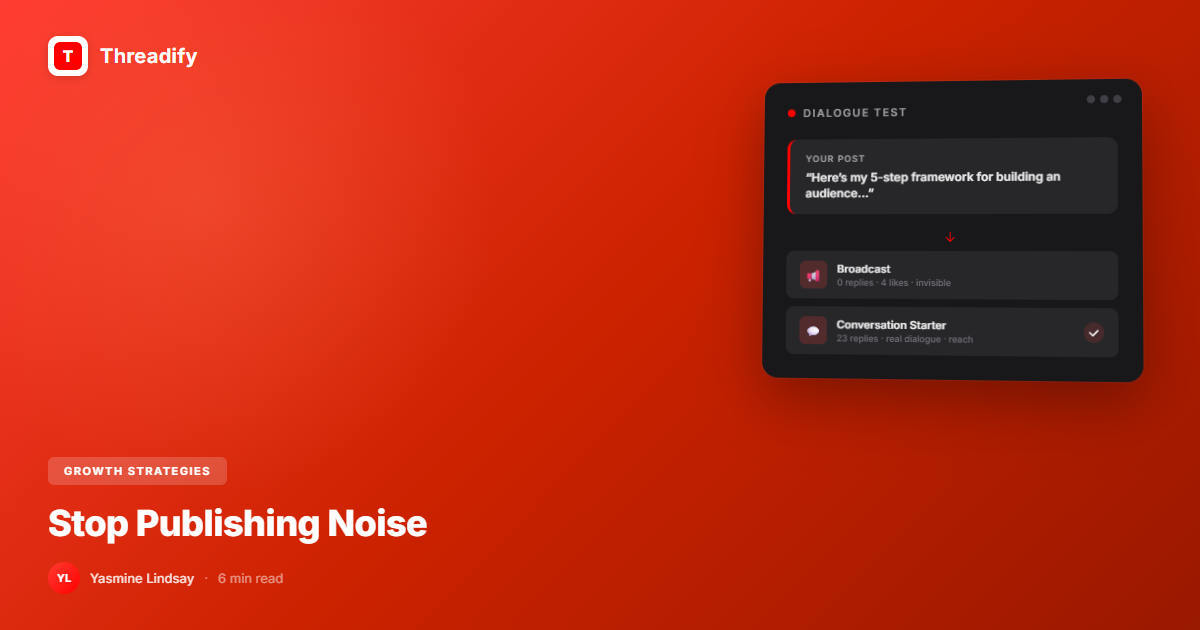
Stop Publishing Noise: How to Create Content That Starts Real Conversations
Most social media content is noise — generic, forgettable, and reply-free. Here's how to tell if yours is contributing to the problem, and the dialogue test that fixes it.

Stop Publishing Noise — Start Publishing Dialogue
What is content noise?
Content noise is any post that delivers information without creating a reason for response. It fills feeds without changing behaviour or starting conversations. Content dialogue is the opposite: specific enough to provoke a response, honest enough to build trust, and incomplete enough to invite participation. The shift isn't about quality — it's about intent. Are you publishing to be seen, or publishing to be responded to?
Quick Steps: How to shift from noise to dialogue
Ask before posting: "Would I reply to this if someone else posted it?" If no, rewrite.
Replace tips with takes: Opinions generate more conversation than information.
Replace conclusions with questions: Leave something unfinished.
Share the messy process: Not just the polished result.
Track replies, not impressions: Replies are the signal. Everything else is flattery.
The Noise Problem
Open any social media feed right now.
Scroll for 60 seconds.
How many posts made you stop? Not glance — stop. How many made you want to type a response?
If you're like most people: maybe 1. Maybe 0.
The rest was noise.
And here's the uncomfortable part: your content might be contributing to it.
Not because you're a bad creator. Not because your ideas are wrong. But because the default mode of content creation is broadcast — one-directional, polished, conclusive. It delivers value but doesn't invite anything.
It's the content equivalent of a lecture. Informative, yes. Engaging? Rarely.
According to a 2025 Sprout Social Index, 64% of social media users say they feel overwhelmed by the volume of content in their feeds — yet only 3% of posts receive any comments at all. That gap is the noise problem.
The Dialogue Test
Before you hit publish, run your post through this filter:
Question 1: Does this say something only I could say? If your post could've been written by anyone in your niche, it's noise. What makes it yours? Your experience, your failure, your specific take. Generic advice is everywhere. Your story is not.
Question 2: Is there a reason to disagree? If everyone would nod and keep scrolling, you haven't said anything. The posts that generate conversation take a position. They draw a line. They say "this is what I think" — and leave room for "but what do you think?"
Question 3: Is there something unfinished? The best dialogue posts aren't complete essays. They're opening statements. They leave a gap that the reader wants to fill. A question. An admission of uncertainty. An observation without a conclusion.
If your post fails all three — don't publish it. It's noise, and noise doesn't build audiences.
What Noise Looks Like (Real Examples)
❌ "5 tips to grow your audience on social media" Generic. Could be written by anyone. No reason to reply. The reader nods, maybe saves it, and forgets.
❌ "Consistency is key to building an audience." True but obvious. No one disagrees and no one cares enough to respond.
❌ "I'm so grateful for this community" Warm but empty. What specifically are you grateful for? Why? What changed?
What Dialogue Looks Like (Real Examples)
✅ "I posted every day for 90 days and I'm not sure it was worth it. Here's what actually moved the needle." Counter-narrative. Specificity. People who posted daily want to know if they wasted their time. People who didn't want to feel validated.
Try Threadify for free
Write better Threads in less time. Generate, refine, schedule—without the chaos.
✅ "Unpopular opinion: engagement pods do more harm than good." A stance. People in pods will defend them. People who left pods will agree. Either way: replies.
✅ "The hardest part of creating content isn't ideas. It's posting when you have 47 followers and your mum is one of them." Vulnerability + specificity + shared experience. Everyone who's been there wants to say "literally me."
The Threadify Score Contrast
Before publishing, running your post through Threadify Score shows you the gap in real time:
Weak hook: "Tips for creating better social media content" — Threadify Score: 22/100. Generic, zero friction, unmemorable.
Fixed hook: "I deleted my best-performing post because it was a lie. Here's what I replaced it with." — Threadify Score: 94/100. Tension, specificity, story promise.
The difference isn't talent. It's intention.
The Spectrum: Noise, Signal, Dialogue
Content isn't binary. It moves along a spectrum:
Noise — Generic, interchangeable, conclusive. Example: "5 tips to boost engagement." Result: low — likes only.
Signal — Specific, useful, informed. Example: "I tested 3 posting times for 30 days. Here's what worked." Result: medium — saves and shares.
Dialogue — Personal, incomplete, provocative. Example: "I tested 3 posting times and the results contradicted everything I believed." Result: high — replies and debates.
Operate between Signal and Dialogue. Signal builds trust. Dialogue builds community. Noise builds nothing.
The Publishing Noise Detox
If you suspect you've been publishing noise — no judgment, most people are — try this 7-day reset:
Day 1-2: Don't post. Just read your replies from the last month. What topics generated actual responses? What got ignored?
Day 3-4: Post one thing per day that shares a genuine struggle, mistake, or unpopular opinion. Not tips. Not advice. A thought.
Day 5-6: Post one thing per day that asks a real question. Not "what do you think?" but "How do you handle [specific thing] when [specific constraint]?"
Day 7: Post a reflection on what you learned from the experiment. Be honest about what felt different.
Most people who do this detox never go back to publishing noise. Once you feel the difference in engagement quality, generic tips feel empty.
Why Dialogue Is Harder (And Why That's the Point)
Publishing noise is easy. You Google "Threads tips," rewrite the top result in your voice, done.
Publishing dialogue requires:
Admitting what you don't know
Taking positions you might have to defend
Sharing stories that make you vulnerable
Asking questions you don't have answers to
It's harder because it's real. And real is what people respond to.
The algorithm can't tell the difference between good writing and bad writing. But it can absolutely tell the difference between posts that generate 0 replies and posts that generate 20. Guess which one it amplifies?
Your Next Step
Pull up your last 5 posts. Run each one through the dialogue test:
Could only I have written this?
Is there a reason to disagree?
Is there something unfinished?
If any post fails all three, rewrite it. Or write something new that passes all three.
Then post it. And reply to every single person who responds.
That's the shift. From noise to dialogue. From broadcasting to building.
If you want a faster way to run the test before every post, Threadify Score runs this analysis automatically and tells you exactly what to fix.
Related reads:
Conversations > Broadcasts — why the creators who talk back win on Threads
We Analysed 500 Viral Posts From Threads — the structural patterns behind high-performing content
Score It Before You Post It — the pre-publish quality system that catches noise before it ships
Frequently Asked Questions
What is content noise on social media?+
Content noise is any post that delivers information without creating a reason for response. It fills feeds without changing behaviour or starting conversations. The metric for noise is impressions. The metric for dialogue is replies.
How do I know if my content is noise?+
Run the dialogue test before every post. Ask: Does this say something only I could say? Is there a reason to disagree? Is there something unfinished? If your post fails all three, it is noise. Rewrite before posting.
Why do social media posts not get replies?+
Most posts fail to get replies because they are designed for consumption, not conversation. Posts that generate replies take a position, share a vulnerability, or leave an intentional gap that the reader wants to fill.
What is dialogue content?+
Dialogue content is designed to provoke thought, invite disagreement, or create shared moments. It is personal enough that only you could have written it, specific enough to feel real, and incomplete enough that readers feel compelled to respond.
How do I write Threads posts that get replies?+
Replace tips with opinions, replace conclusions with open questions, and share the messy process instead of the polished result. Before posting ask: Would I reply to this if someone else posted it? If not, rewrite.
Try Threadify for free
Write better Threads in less time. Generate, refine, schedule—without the chaos.