A Simple Threads Marketing Plan for Coaches Who Don't Want to Post All Day
Build a useful weekly Threads plan from real client questions, one clear offer and a review loop that doesn't take over your working week.

A Simple Threads Marketing Plan for Coaches Who Don't Want to Post All Day
You didn't become a coach so content could eat the part of your week meant for actual clients.
Yet every time you open a blank Threads draft, it feels like you need a new idea, a perfect hook and a 30-day plan before you can say anything useful.
You don't.
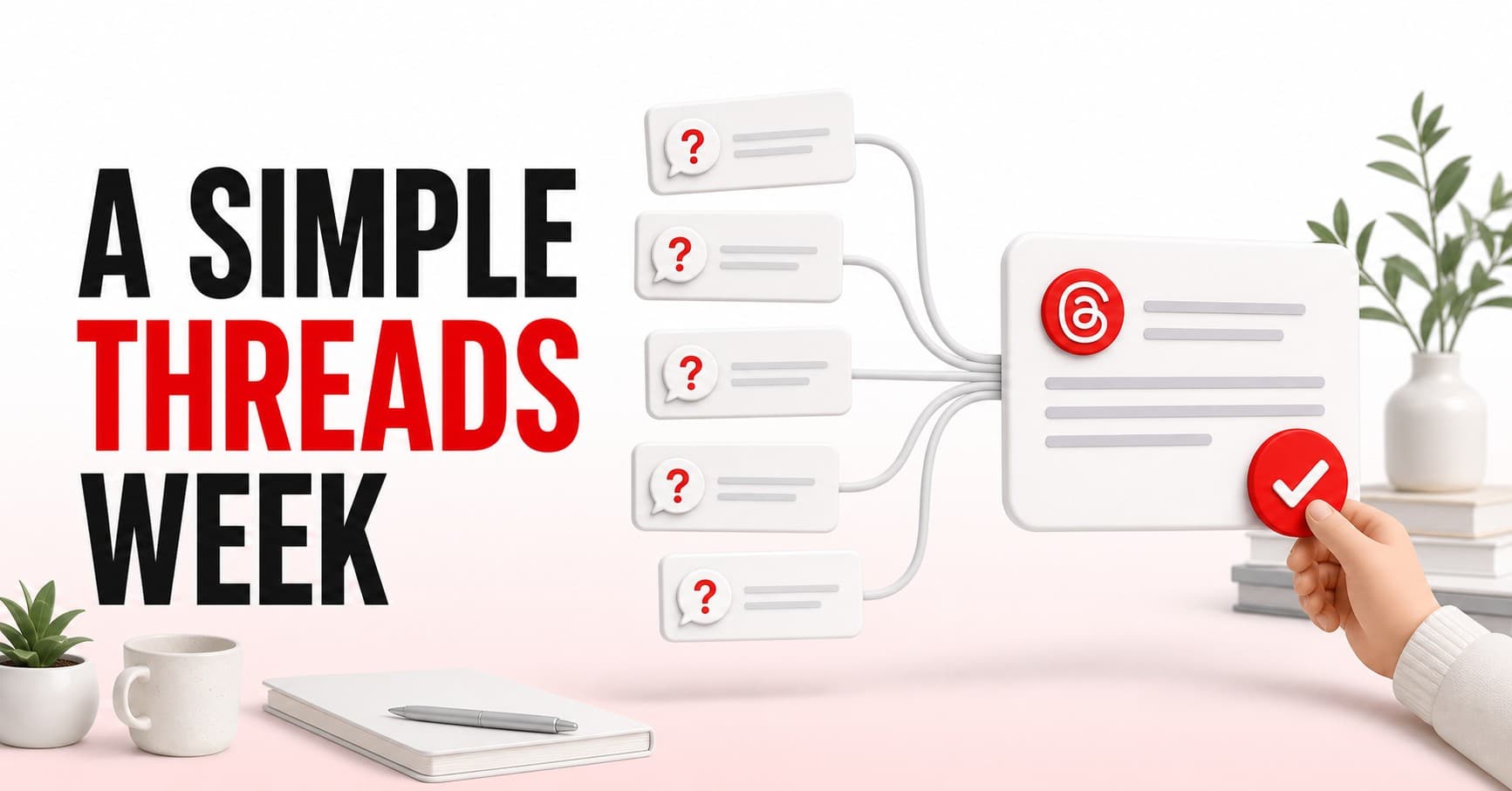
You need a small loop built from questions your clients already ask, one clear offer and enough review to learn what deserves another go.
Start with the job, not the posting target
Before you decide how often to post, choose what Threads needs to help you do.
For most coaches and consultants, that job is one of these:
help the right person recognise their problem
show how you think about a decision
answer an objection before a sales conversation
start a useful reply that can continue naturally
Pick one for the week.
If you try to build awareness, prove your expertise, tell your life story and sell the offer in every Thread, the reader gets a pile of content with no clear point.
One week. One reader problem. One next step.
Find five questions you can answer without pretending
Useful source material is often already sitting in your work.
Look at:
questions clients ask before they begin
mistakes you keep correcting
advice people understand but struggle to apply
objections that delay a useful decision
phrases people use when they describe the problem themselves
Keep the material public-safe. Remove names and identifying details. Don't turn a private client moment into content because it makes a neat story.
Write five questions in plain language. Not content titles. Questions.
For example:
How do I know whether I need a better plan or I just need to start?
That question can become a practical answer, a short story, a mistake to avoid or a decision checklist. The truth stays the same. The job changes.
Give each Thread one job
Use a simple mix based on reader decisions rather than a fixed percentage.
Help them recognise the problem
Name the moment they already know.
You've rewritten the plan three times because starting would make it real.
Help them understand your approach
Explain one choice or trade-off.
A detailed plan helps when the work is unclear. It becomes avoidance when the next action is already obvious.
Help them do one useful thing
Give a small step they can use today.
Write the next action in a sentence that starts with a verb. If it takes more than one sitting, make it smaller.
Help them decide whether your offer fits
Answer a real objection honestly. Say who it is for, who it isn't for and what the next step actually involves.
You don't need all four every week. Choose the jobs that fit the questions you have and the offer you can genuinely support.
Write the first version before you edit it
Trying to draft and judge every sentence at the same time is how one Thread becomes an afternoon.
Write the complete thought first:
Try Threadify for free
Write better Threads in less time. Generate, refine, schedule—without the chaos.
What is happening for the reader?
What are they getting wrong or missing?
What is the useful shift?
What should they do next?
Then edit.
Cut the throat-clearing. Replace broad claims with a concrete example. Remove the sentence that sounds impressive but doesn't help. Read it out loud and keep the words you would actually say.
If it sounds like anyone could have written it, the problem usually isn't the punctuation. It needs more real context.
This guide to building Threadify's Knowledge Base shows what useful voice material looks like before a draft is generated.
Leave room for the reply
Threads is more useful when the post is an opening, not a lecture wearing casual clothes.
You don't need to force a question onto every ending.
You can finish with:
a clear next step
a truthful observation
one decision the reader can make
a genuine question you actually want answered
When replies arrive, don't treat every person as a lead.
Some people are agreeing. Some are adding their experience. Some need support. Some are showing real intent.
Use this guide to spot buyer intent in Threads replies without DMing everyone.
The relationship comes first. Threadify can help you notice and organise the signal, but you still decide whether a follow-up is useful.
Give the offer one honest place
If your Threads never connect to your work, readers have to guess what the next step is.
If every Thread pitches, they stop trusting the useful part.
Choose one offer for the week. Mention it when it naturally continues the problem you just helped with.
A useful CTA tells the reader:
what happens after the click
what they will be able to try or review
whether they need an account, payment or conversation
what is still their decision
You can also read how coaches can follow up without sounding like a bot before deciding how a public reply should continue.
Review the week without turning it into a personality test
At the end of the week, look at the Threads that created something useful.
That might be:
a specific follow-up question
language that explains the problem better than you did
a profile visit or qualified click
a reply from someone who fits your work
an idea people saved, shared or asked you to explain
Keep the sample and timeframe visible. One strong Thread doesn't prove a formula. One quiet Thread doesn't mean your audience has disappeared.
Choose one lesson for the next week.
Maybe the reader problem needs to be clearer. Maybe the example was too vague. Maybe the CTA asked for too much. Maybe the idea deserves a different job.
Change one thing and keep going.
The whole plan
Choose one reader problem for the week.
Pull five real, public-safe questions from your work.
Give each Thread one job.
Draft first and edit after.
Reply like a person, not a funnel.
Give one offer one honest place.
Review the useful signals and change one thing.
That is a Threads marketing plan.
It doesn't need to become another full-time job before it counts.
Start my 7-day Threadify trial
Build your first reviewed week from real questions, then decide what should be published. Threadify drafts and organises the work. You keep the final say.
Frequently asked questions
How often should a coach post on Threads?
There is no universal posting number. Choose a pace that lets you publish useful Threads and reply properly without harming your client work. Start with a repeatable week, then adjust using your own evidence.
What should coaches post about on Threads?
Start with real client questions, common mistakes, objections and decisions. Keep examples anonymous and public-safe. Each Thread should help one reader do or understand one thing.
Do I need a 30-day Threads content calendar?
No. A small weekly loop is enough to begin. A longer calendar can help later, but it shouldn't become a reason to delay the first useful Thread.
How do I promote coaching without sounding salesy?
Connect the offer to the problem you just helped with, explain the next step clearly and keep one primary CTA. Don't force an offer into every Thread or pretend a reader's reply is buying intent.
Can Threadify publish automatically for me?
Threadify can support drafting and publishing workflows according to your account settings. The permission-first default is to review the work and keep control of public actions. Check the current setting before relying on any automation.
Frequently Asked Questions
How often should a coach post on Threads?+
There is no universal posting number. Choose a pace that lets you publish useful Threads and reply properly without harming your client work. Start with a repeatable week, then adjust using your own evidence.
What should coaches post about on Threads?+
Start with real client questions, common mistakes, objections and decisions. Keep examples anonymous and public-safe. Each Thread should help one reader do or understand one thing.
Do I need a 30-day Threads content calendar?+
No. A small weekly loop is enough to begin. A longer calendar can help later, but it shouldn't become a reason to delay the first useful Thread.
How do I promote coaching without sounding salesy?+
Connect the offer to the problem you just helped with, explain the next step clearly and keep one primary CTA. Don't force an offer into every Thread or pretend a reader's reply is buying intent.
Can Threadify publish automatically for me?+
Threadify can support drafting and publishing workflows according to your account settings. The permission-first default is to review the work and keep control of public actions. Check the current setting before relying on any automation.
Try Threadify for free
Write better Threads in less time. Generate, refine, schedule—without the chaos.